Thursday, April 05, 2018
What If?
I tend to be a generally positive person, but the way things are going lately, it's hard to keep looking on the bright side, especially when the bright side could be an atomic fireball generated by someone who doesn't know how to handle the power at his fingertips. After all, just claiming to have a bigger button than the other guy isn't a very mature way to approach something as ugly as nuclear war.
Here's something I found online a week or so ago: a generator that overlays the effects of a nuclear detonation over your choice of targeted area. You can choose among four different nuclear weapons of increasing power, the lowest being the 15 kiloton "Little Boy" dropped on Hiroshima during World War II, and the highest being the 50,000 kiloton* Russian "Tsar Bomba;" the default value is the W-87 warhead carried by the US Minuteman III ICBM, which has a yield of 300 kilotons. You can also choose between a surface explosion and an air explosion.
I ran the model with a surface burst of a W-87 warhead centered on the White House. The estimated results were 303,476 killed, 258,126 injured.
Just a little something for you to think about when you think about those who cavalierly talk about using the nuclear arsenal.
Sleep well.
Have a good day. More thoughts tomorrow, when we return to happier topics with more Great Moments in Editing and Signage.
Bilbo
* That's 50 million tons of TNT.


Wednesday, April 04, 2018
Things We Don't Learn Any More
When I was growing up, my parents insisted that we show respect and good manners. They set the example, and expected us to follow it.
Nowadays, I don't think that there are many parents who themselves know how to show respect and good manners, and many of them certainly aren't passing them on to their children. Among the lessons they aren't passing on are the ones noted in this article I found yesterday -10 Things That Used To Be Basic Manners That Kids Today Have Never Learned ... with my commentary, of course ...
1. Basic words of courtesy. Words like "please," "thank you," and "you're welcome" are in short supply nowadays, and even pleasant greetings like "good morning" and "good evening" don't often make an appearance. Being pleasant and respectful toward people evidently diminishes one's "street cred," or creates a sense of putting oneself in a subordinate position to others.
2. Taking care of your appearance. I can't imagine what sort of impression some people want to make when they have their pants hanging halfway down their backsides, or a baseball cap worn at a stupid angle. I don't put on a coat and tie to make a simple trip to the store, but I at least try not to look like Freddie the Freeloader when I go out.
3. Proper posture. I was always taught to stand up straight. Not only does it make a better impression, but it turned out to be very useful when I got into ballroom dancing, and my good frame (dance posture) helped compensate for my many footwork mistakes.
4. Sending handwritten thank-you notes. Most people don't even know cursive writing any more, so this one's not surprising. Sending a thank-you e-mail is more-or-less okay in today's technical world, but not sending a thank-you at all, or doing it by SMS, is pretty gauche.
5. Table manners. I'm sometimes guilty of putting my elbows on the table, but I do try to use the good table manners my parents taught me. It's pretty shocking to see how some people in restaurants comport themselves while they eat.
6. Rising when an older person enters the room. I was always taught that it was a sign of respect to stand up when an older person or a lady entered the room. You don't see that much any more, and I seldom see anyone stand up for a lady. This may be a function of our drive for gender equality in all things, but I still think it's sad.
7. Sitting with your ankles crossed. This one applies more to ladies, and I'm not sure that I agree that this is a problem any more ... or perhaps I just associate with ladies who have been raised in a more genteel home.
8. Taking off your hat indoors. Well, who wears hats any more, except for those idiots who wear cockeyed baseball caps? Just take it off, okay?
9. The woman decides when the night ends. It's always good when the lady gives a signal what she expects ... it can save a lot of agony and embarassment.
10. "Make an offer." I'd never heard of this one ... I was always taught that if I asked a lady out, I should expect to bear the cost of the date. Nothing wrong with "going Dutch," but I would never expect someone I'd asked out to offer to pay part of the cost. Maybe it's just me.
Are there any other lost signs of good manners that you have noticed? Leave a comment.
Have a good day, and use respect and good manners. It doesn't cost extra.
More thoughts tomorrow.
Bilbo
Tuesday, April 03, 2018
Thinking About the Health Care System, Part 3
This is the third in a series of posts about the state of health care in the United States. You can read the first two posts of the series here and here; the series will culminate with my plan for rebuilding and improving the country's health care system, which will appear in a few days.

The premise of my series and my eventual recommendation is that there are several underlying causes for the dysfunction and outrageous cost of our health care system. The first was
We are conditioned by our history to stress individual responsibility and self-reliance. A real American takes care of himself and does not expect others to carry his weight.
The second was
Americans believe that the free market will always deliver a better, cheaper product or service than any government-run alternative.
Today, I present what I believe is the third fundamental cause -
When payment for health care is dependent upon the provisions of policies issued by insurance companies (which, by the way, are profit-motivated), a doctor or other provider must maintain a business staff whose sole purpose is to interact with dozens of policies issued by myriad insurance companies to figure out what the policies will pay for, which, in turn, drives the doctor's decisions on how to treat the patient.
If you are one of those people who howled about the horror of the "death panels" which supposedly would make treatment decisions under Obamacare, you may want to consider that the actual equivalent of death panels are the insurance agency actuaries who decide on what their specific policies will cover, cover in part, or not cover. And because every insurance company designs its own policies and writes them based on its own assessment of the risks posed by each patient, it's impossible for a doctor to know what he or she can do - and be paid for - to treat each patient. This means that
1. The insurance company actuaries are the people actually driving decisions about the patient's health care.
2. Because each company's policies are constructed differently, and are different for each patient, each doctor or medical group must maintain a staff dedicated to communicating with all the different insurance sources represented by their patients. This represents a sizeable cost that is passed on to the patients, and does not contribute materially to their care.
3. A tangential issue is that the average medical insurance policy doesn't cover all the health problems you might have - most policies do not cover vision care or dental care, both of which can be extremely expensive and require their own insurance policies ... which suffer from the same issues we've discussed already.
So, Dear Readers, part 3 of our look at the health care mess deals with the fragmented nature of the health insurance system.
We'll wrap up this discussion in a few days, when I discuss my proposal for revising the current system. Until then, stay healthy ... you probably can't afford to get very sick.
Have a good day. More thoughts coming.
Bilbo
We are conditioned by our history to stress individual responsibility and self-reliance. A real American takes care of himself and does not expect others to carry his weight.
The second was
Americans believe that the free market will always deliver a better, cheaper product or service than any government-run alternative.
Today, I present what I believe is the third fundamental cause -
The fragmented design of our insurance-based health care system imposes enormous administrative costs on providers, which are passed on to the patient.
When payment for health care is dependent upon the provisions of policies issued by insurance companies (which, by the way, are profit-motivated), a doctor or other provider must maintain a business staff whose sole purpose is to interact with dozens of policies issued by myriad insurance companies to figure out what the policies will pay for, which, in turn, drives the doctor's decisions on how to treat the patient.
If you are one of those people who howled about the horror of the "death panels" which supposedly would make treatment decisions under Obamacare, you may want to consider that the actual equivalent of death panels are the insurance agency actuaries who decide on what their specific policies will cover, cover in part, or not cover. And because every insurance company designs its own policies and writes them based on its own assessment of the risks posed by each patient, it's impossible for a doctor to know what he or she can do - and be paid for - to treat each patient. This means that
1. The insurance company actuaries are the people actually driving decisions about the patient's health care.
2. Because each company's policies are constructed differently, and are different for each patient, each doctor or medical group must maintain a staff dedicated to communicating with all the different insurance sources represented by their patients. This represents a sizeable cost that is passed on to the patients, and does not contribute materially to their care.
3. A tangential issue is that the average medical insurance policy doesn't cover all the health problems you might have - most policies do not cover vision care or dental care, both of which can be extremely expensive and require their own insurance policies ... which suffer from the same issues we've discussed already.
So, Dear Readers, part 3 of our look at the health care mess deals with the fragmented nature of the health insurance system.
We'll wrap up this discussion in a few days, when I discuss my proposal for revising the current system. Until then, stay healthy ... you probably can't afford to get very sick.
Have a good day. More thoughts coming.
Bilbo
Monday, April 02, 2018
Linguistic What-Ifs
What do you suppose the person who invented the walkie-talkie would have called other things if he (or she) had invented them?
Postage Stamp = Lickie Stickie
Defibrillator = Hearty Starty
Bumble Bee = Fuzzy Buzzy
Home Pregnancy Test = Maybe Baby
Bra =Breastie Nestie
Fork= Stabby Grabby
Socks = Feetie Heaties
Hippopotamus = Floaty Bloaty
Nightmare = Screamy Dreamy
Any other suggestions? Leave a comment.
Have a good day. More thoughts tomorrow.
Bilbo
Sunday, April 01, 2018
Musical Sunday
There aren't a lot of songs that are fun, tell a good story, and deliver a punch. This one by Marty Robbins is one of my favorites ...
Have a good day. More thoughts tomorrow.
Bilbo
Saturday, March 31, 2018
Cartoon Saturday
It's the last day of March. Finally.
North Korean dictator Kim Jong-un traveled to Beijing for a meeting with Chinese president Xi Jinping, presumably in preparation for Kim's possible upcoming meeting with Donald Trump; in the latest Cabinet shakeup, Donald Trump replaced Veterans' Affairs director David Shulkin with Ronny Jackson, Trump's doctor ... a respected combat surgeon and military veteran, but without signifiant management expertise; retired Supreme Court justice John Paul Stevens called for a repeal of the Second Amendment, throwing the NRA into paroxysms of delight at hearing a despised liberal hand them a gold-plated talking point; Nobel Peace Prize winner Malala Yousafzai returned to Pakistan for the first time since being shot in the head by Taliban militants at age 15 for advocating education for Pakistani girls; and in an attempt to put a happier face on the White House press operation, former Disney Channel teen star Caroline Sunshine was hired as a press assistant. I did not make that up.
This week, in honor of Donald Trump and the Right's fixation with fake news (defined as anything with which they do not agree, or find unflattering), we have a collection of cartoons about the news media ...
Making news channel selection easier ...

The stupid chyrons* crawling around the screen drive me crazy ... how about you? ...

And speaking of chyrons ...

There are people who distrust the media that much ...

True. Especially on Faux News ...

Summing it all up ...
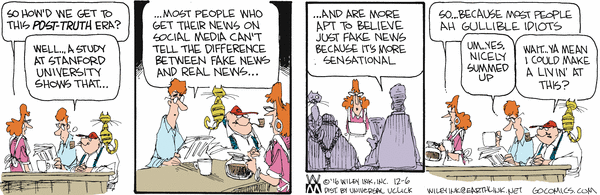
Well, of course you do ...

Now this is what I call brutal and inhumane torture ...

That's how it works, isn't it? ...

Yes. Yes, they have ...

I don't know about you, but I don't know what I'd do without the cartoons to take the edge off the news.
It looks like it'll be a good, if chilly weekend here in NoVa, where we're keeping our gardening fingers crossed for the eventual arrival of spring ... at the rate we're going, probably sometime in June. Oh, well ... at least I'll have plenty of time to fix up the garden plots I won't be able to plant in for a while.
Have a good day and a great weekend. More thoughts tomorrow.
Bilbo
It looks like it'll be a good, if chilly weekend here in NoVa, where we're keeping our gardening fingers crossed for the eventual arrival of spring ... at the rate we're going, probably sometime in June. Oh, well ... at least I'll have plenty of time to fix up the garden plots I won't be able to plant in for a while.
Have a good day and a great weekend. More thoughts tomorrow.
Bilbo
* Or, as Dr Edward Tufte would call them, "chartjunk."
Friday, March 30, 2018
The On-Crack Ass Clown for March, 2013
As we prepare to depart the seemingly never-ending month of March, the calendar gives us a third opportunity to provide targeted dishonor to a worthy recipient. And thus it is that we present the award for
The On-Crack Ass Clown for March, 2018

to
Cambridge Analytica

In case you are one of the two or three people who are unaware of the story, Cambridge Analytica is the company that harvested the personal data of tens of millions of Facebook account holders and used it to develop "psychographic profiles" that enabled the Trump campaign to develop and deploy political ads on Facebook that were precisely targeted to the personalities and preferences of potential Trump supporters. The company also apparently assigned dozens of non-U.S. citizens to provide campaign strategy and messaging advice to Republican candidates in 2014, an activity illegal under US election law. And in addition, the company CEO, Alexander Nix, is under investigation in the UK after he was captured on video claiming that Cambridge Analytica operatives could entrap political rivals in far-off lands with beautiful Ukrainian women.
Back in 1957, journalist Vance Packard published his landmark book The Hidden Persuaders that detailed how the advertising industry employed all sorts of clever tricks to manipulate consumers. Today, with all the vast amounts of data we expose, willingly or not, 21st century hidden persuaders like Cambridge Analytica can help shameless political hacks to steal elections.
Ladies and gentlemen, Dear Readers, Cambridge Analytica is named as our On-Crack Ass Clown for March, 2018. They've got your number.
Have a good day. More thoughts tomorrow, when Cartoon Saturday returns.
Bilbo
Back in 1957, journalist Vance Packard published his landmark book The Hidden Persuaders that detailed how the advertising industry employed all sorts of clever tricks to manipulate consumers. Today, with all the vast amounts of data we expose, willingly or not, 21st century hidden persuaders like Cambridge Analytica can help shameless political hacks to steal elections.
Ladies and gentlemen, Dear Readers, Cambridge Analytica is named as our On-Crack Ass Clown for March, 2018. They've got your number.
Have a good day. More thoughts tomorrow, when Cartoon Saturday returns.
Bilbo
Thursday, March 29, 2018
Thinking About the Health Care System, Part 2
Last week, I posted the first of a series of articles on the topic of our health care system in America. My intent is to focus first on how it became the contorted mess it is today, and finish with my proposal for how to fix it.

Americans believe that the free market will always deliver a better, cheaper product or service than any government-run alternative.
Well, maybe.
There's certainly no argument that a capitalist, profit-driven free market system has worked well for the United States. We have, on average, a high level of prosperity and quality of life, and access to a range of goods and services most other nations might envy. But is a profit-driven free-market system the best approach to the delivery of medical care if the people who need it can't afford it?
Those who advocate the free-market approach to health care claim that providers who charge too much ("more than the market will bear") will be driven out of business by their cheaper competitors. This sounds pretty good in theory, but if it were true, we wouldn't have the problem of unaffordable health care we have now, would we?
Consider that it's economically advantageous for a profit-driven system to keep the prices for services as high as the market will bear*. Consider also that manufacturers of drugs do not have an economic interest in developing medications to address rare illnesses and conditions. These do not speak highly of the capitalist free market as a particularly good approach to moderating the cost of health care.
Most developed countries have a government run national health insurance program, sometimes with optional insurance plans available for those who can afford them. In general, these programs work well, although - as with any system - there are apocryphal horror stories. Americans, though, are conditioned to assume the superiority of the free market and to believe the relentless drumbeat from the right that anything run by the Big Bad Government™ is by definition doomed to failure because of gross government ineptitude.
So, my proposed second major reason for the health care mess is a belief embedded in the American DNA that only a capitalist, free-market approach to health care is acceptable.
We'll look at my proposed third reason in the next installment of this series, coming in a few days.
Have a good day, if you can afford it. More thoughts tomorrow.
Bilbo
* I'm reminded of the famous comment by French economist Jean-Baptiste Colbert about taxation, that "The art of taxation consists in so plucking the goose as to procure the largest quantity of feathers with the least possible amount of hissing." In the case of health care, we all know who's getting plucked.
Wednesday, March 28, 2018
Witch-Proof Windows
I find all sorts of amazing things online. Some of them are amazing because I can't believe anyone would believe such a load of bovine excrement*, and others are amazing because ... well ... they just are.
In the second category comes this interesting article I found the other day - The Witch-Proof Windows of Vermont.
It seems that an architectural oddity of many old Vermont farmhouses is a crooked window tucked up under the eaves at a crazy angle, as in this example -

Another rationale mentioned in the article is that the angled windows are "coffin windows," which supposedly make it easier to move a body in a coffin from the second floor without having to navigate a narrow or crooked staircase ... one just slides it out through the window and down the roof. Hmmm ... I would have thought it would be easier just to carry the body downstairs and put it in the coffin outside, but then, I have limited experience with moving bodies**.
Or if the purpose of the crooked window is to keep out unwanted evil spirits, why not install crooked doors to ward off door-to-door salesmen, religious flacks, and political pollsters?
I would have thought the most logical explanation was that the windows were installed by the lowest bidder.
So, Dear Readers, have you ever seen or heard of a Vermont "witch window," or have you lived in a house that had one? What do you think is the best explanation for having a window like that in your house? Leave a comment.
Have a good day. Use screens to keep flying things out of your windows, crooked or not. More thoughts tomorrow.
Bilbo
* Pretty much anything tweeted by Donald Trump or generated by the NRA, for example.
** Although the events of the last year or two have caused me to consider making a detailed study of the issue.
Tuesday, March 27, 2018
"Assume Good Faith"
I carry a pocket notebook* in which I jot down random ideas, quotes I've heard, ideas for blog posts, things we need to pick up on the next trip to the grocery, etc. I also have two notebooks and a blotter on my desk in the study for the same purpose. Every once in a while I go back and page through the notebooks and old blotter pages to see what I wanted to remember and think about why I was inspired to write it down.
In the middle of a page of one of the old notebooks I read through the other day was this phrase:

"Assume good faith" is a nice idea, but nowadays it doesn't seem like a very good assumption.
It's hard to assume good faith when a president rails about "fake news" ... and then goes ahead and does exactly what was reported.
It's hard to assume good faith when some Members of Congress put party loyalty over discovering the truth about threats to our democracy.
It's hard to assume good faith when our children who have been the victims of school shootings and are demonstrating against the easy availability of deadly weapons are insulted and demonized rather than listened to.
It's hard to assume good faith when a police officer blatantly lies in court about the circumstances surrounding a traffic stop**.
I'd like to be able to assume good faith, but I'm a man of experience ... and recent experience on many fronts has led me to assume good faith only on the part of those I most trust.
There are fewer of those all the time.
Have a good day. Assume good faith at your own risk. More thoughts tomorrow.
Bilbo
* So did Leonardo da Vinci. I'm in good company!
** But it's better than being shot.
Subscribe to:
Posts (Atom)