Monday, October 08, 2012

One Happy Island


The final stop on our vacation was the beautiful island of Aruba, a mere 17 miles from the coast of Venezuela* in the Caribbean Sea. The unofficial motto is "One Happy Island," and it is ... it was one of the most pleasant, beautiful, and return-worthy places we visited on the cruise!

The good ship Coral Princess arrived in the harbor of Oranjestad** at about 12:30 in the afternoon, and soon thereafter we were off and running on our whirlwind tour of the island. Our first indication that Aruba was, indeed, one happy island was this tour bus waiting for passengers ...


We had signed up for a tour titled "Semi-Submarine, Shipwreck, and Island Drive," and it began with a short bus ride to the DePalm pier and a transfer to a boat which took us offshore to another ship, the Seaworld Explorer ...


This was advertised as a "semi-submersible" vessel, meaning that we boarded from our transfer boat, passed through the hatch visible on the left (port) side, and went down a steep stairway to two rows of seats next to large windows below the waterline. Once we were all aboard, the captain motored us a bit further out to sea, where he cruised in a large circle around the wreck of the freighter Antilla. The Antilla was a German ship that was scuttled by her crew in May of 1940 rather than being surrendered to the Dutch, and the wreckage now serves as a haven for large schools of fish and a budding coral reef. It was difficult to take pictures from inside the Seaworld Explorer, but this one gives you a small example of what we were able to see from our dry seats under the water ...


When our underwater tour was finished, we transferred back to the transit boat and returned to the dock to re-board the bus and head to our next stop - the California Lighthouse. This is a picture of the lighthouse I shot from the boat, and it gives you a good idea of the beautiful white sand beaches and sapphire-blue water for which Aruba is justly famous ... 


However, most of the rest of the island was, as we were soon to learn, a bit different ...

Unlike the other places we'd visited on our cruise, where the temperature was usually in the mid- to upper nineties and the humidity in the high 90% range, the climate on Aruba is very dry, with mild temperatures (low 80's the day we were there) and pleasant sea breezes. There is almost no fresh water on the island - drinking water is provided by desalinization plants - and the landscape is not tropical, as I'd expected, but arid. Most of the interior of the island was not much different from Arizona, with all sorts of cactus and thorny plants predominating. This picture shows one of the highest points on the island, the Hooiberg ("haystack"), with typical plant life surrounding it ...


We drove around the island to the site of the California Lighthouse, named for the ship California, which sunk in 1908, two years before the lighthouse was built. As it turned out, there was no particular reason to visit the lighthouse, as it has been closed to visitors for several years, ever since someone decided to try a vertical descent from the top rather than negotiate the stairs. This is too bad, as the views from the top would have no doubt been spectacular. As it was, the stop simply offered a chance to use the rest rooms at a nearby restaurant (for a 50-cent fee), purchase a drink from a tourist-trap kiosk, and take lots of pictures of thorny cactuses (cacti?).

Leaving the lighthouse, we continued on to the Casibari Rock Formation, which is ... well ... a formation of large rocks. It's an interesting and picturesque area, but I've seen lots of rocks before in other places that were a bit more interesting and picturesque. Here's a picture of one part of the area to give you an idea of what it looks like ...


From there, we headed out to the northern end of the island and the much-ballyhooed  "Baby Natural Bridge." It seems that the large and relatively imposing original natural bridge, carved out by centuries of surf pounding against the shore, collapsed a few years ago. In order to have a reason for tourists to continue returning to this end of the island, a much smaller (baby) natural bridge was selected as the new focus for visitors. This is how the original bridge looks now ...


... and this is the new bridge ... the sign on top of the arch just right of center warns people to stay off, as they'd rather this one not collapse, too ...


Do you remember those beautiful white sand beaches we talked about earlier? Not here. On the northern end of the island the landscape is starkly beautiful, with blue seas and white surf breaking against dark, jagged rocks, as shown in these pictures ...


You really don't want to go barefoot on these beaches!

On the drive back to the harbor I took a number of pictures from the bus of Aruban architecture and landscaping. Most of the houses are painted orange, white, blue, or a combination thereof, and there aren't a lot of flowers in evidence, compared to the more tropical locations. Most of the pictures I shot didn't come out very well because of the reflections on the bus windows, but this one isn't too bad, and shows a pretty typical example of both architecture and landscaping. You can't see much of the house, but trust me - it's there ...


And so ended our all-too-short visit to the beautiful island of Aruba. Of all the places we visited on this trip, the two we'd probably most like to revisit are Costa Rica (for the hot springs) and Aruba (for the ambience and lovely climate). And Costa Rica also offered a beautiful sunset ...


That's all for now. Tomorrow, I'll regale you with a few general comments and observations on our trip, and a few last pictures. Be here.

Have a good day. More thoughts tomorrow.

Bilbo

* Where Hugo Chavez won yesterday's election in the name of his "Bolivarean Revolution." Somehow, I think the great South American hero Simon Bolivar would have considered Mr Chavez an odious buffoon.

** The name means "Orange City." Since Aruba is an autonomous part of the Kingdom of the Netherlands, many signs and place names are in Dutch, rather than Spanish or the native Indian language, Papiamento. Oranjestad is the capital of Aruba, which is also one of the so-called "ABC Islands" - Aruba, Bonaire, and Curacao.

Sunday, October 07, 2012

We Visit Cartagena, Colombia ... for a Few Hours


On Friday, I shared some commentary on our visits to Puntarenas, Costa Rica and Fuerta Amador, Panama, and our trip through the Panama Canal. Today, I have a few comments and pictures on our brief visit to Cartagena, Colombia.

The Coral Princess docked in Cartagena shortly before 8:00, and by 8:30 we were off the ship and on our bus for a short tour of the old city (and the obligatory shopping expedition which seems to be mandatory for all cruise ships stopping anywhere). You don't really need to go to the stores to shop, though, because there are vast swarms of street vendors everywhere, selling everything from Panama hats (in Colombia?) to Cuban cigars to t-shirts to Colombian lace tablecloths (many of them actually made in China, if you look closely at the tags). The street vendors were annoying and persistent, but not as aggressively in-your-face as those we encountered when we visited Mexico ... most of the time they would actually go away if you told them "no."

Our first stop was at the fortress of San Felipe de Barajas, an imposing edifice perched high on a hill overlooking the city, and built to protect the Spanish treasure fleets from pirates and English privateers. Yes, the hike up the hill is as steep as it looks ... and as #$@%! hot and humid as it was, I was pretty well soaked by about a third of the way up ...


This view is from about halfway up the switchbacking hill ... you can see the street vendors with their piles of hats, t-shirts, jewelry, and such arrayed all the way along the road ...


After leaving the fortress and en route to the Mandatory Shopping Place we stopped briefly for a look out over the wall that surrounds the old city. Along with the fortress, it was part of the city's defense against pirates and hedge fund managers*. Very imposing, and very beautiful ...


It was but a short jaunt from there to Playa de las Bovedas (literally translated as something like "Place of the Vaults") ... 


The "vaults" were at one time parts of the city's dungeons, but are now a long series of hole-in-the-wall tourist shops which can be visited by swimming through the sea of street vendors who clog the sidewalks in hopes of poaching customers before they can get to the stores. Note to future visitors: the street vendors will haggle with you (and Agnes is very good at haggling), but the shops will not.

After about 15 minutes at the former dungeon shops, we drove into the center of the old city of Cartagena and disembarked (again through the swarms of street vendors) for a short walking tour. The streets are narrow and colorful, as you can see in these three photos ...


We ended up at the "Palacio de la Inquisition" ("Palace of the Inquisition"), a museum which featured - as you might suspect - gruesome displays of implements of torture once used by the Catholic Church to enforce proper belief in a merciful and loving God. I will not share any of those photos with you. Just around the corner from the main entrance to the palacio was a small, barred window topped with a cross - the "Ventana de la Denuncia," or "Window of Denunciation." It was here that people could slip anonymous notes through the window to denounce their enemies as witches or blasphemers, ensuring that those hapless persons would enjoy the attention of the inquisitors and the tender mercies of the evil devices within ...


There was a pleasant garden in the middle of the palacio complex, where one could rest comfortably in the shade ... there was even a nice swing set which you can see on the left ...


After the sparkling entertainment of that museum, we paid a brief visit to the Church of San Pedro Claver**, the patron saint of slaves, and its associated display of religious art housed in a former monastery. While we were there, we encountered a street vendor who offered (for a fee, of course) the opportunity to pose for pictures with his partner ... 


Well, you can only see so much of fortresses, former dungeons, museums, and displays of religious art before doing what everyone does at cruise stops - shopping. Our last stop of the day was at the Pierino Gallo Shopping Center, which featured dozens of shops selling jewelry, coffee, cigars, and all the other things the street vendors sold, only for many times the cost and tougher haggling (at which Agnes again showed her skill). There was also another fellow lurking outside offering photos with his partner ... a three-toed sloth who charmed Agnes into posing with him. Agnes thought he was cute and cuddly, and when the time was up, the little guy didn't want to let go of her ... the owner had literally to peel him off. I can understand ... I'd rather have her hugging me than that guy.


After the stop at the shopping center, it was time for the bus to deliver us back to the harbor, as the Coral Princess was scheduled to leave Cartagena shortly after 2:00. On the way, the guide drove us past the hotel that became infamous as the Secret Service's party hotel during President Obama's visit to Cartagena earlier this year ... not one of the more inspiring sights of the city, but good for a few laughs.

And that was our all-too-short visit to a very beautiful and colorful city. I'd had some trepidation about visiting Colombia, but because we kept to the safe tourist areas, we had no trouble other than navigating through the swarms of street vendors. I think I'd like to go back again sometime when I could spend more time and see more of the city.

But that's in the distant future. First, we have to discuss the last leg of our vacation ... which will appear in this space tomorrow.

Have a good day. Tomorrow, we'll visit the amazing island of Aruba. Be here.

Bilbo

* Just kidding. About the pirates, ha, ha.

** In an example of bizarre religious imagery, the mortal remains of San Pedro Claver are on display in a gold and glass coffin at the front of the church. I did not feel compelled to take any pictures.

Saturday, October 06, 2012

Cartoon Saturday


And away we go ...

President Obama and Governor Romney held the first of their "debates" this past week, and fact checkers are still searching for facts to check; at least 52 people have been injured in a massive 50-car accident on Florida's I-75; the James Bond secret agent film series turned 50 years old this week; the September unemployment rate took a large dip, causing the Republican National Committee to help lower it still further by hiring hundreds of unemployed conspiracy theorists to explain the bad (for the Romney campaign) news; and in China, thousands of workers at the Foxconn plant where the iPhone 5 is assembled are on strike for better working conditions and more realistic performance standards.

Welcome to October ... and the election is still a month away. It may help to think of it as four more Cartoon Saturdays to go. Good luck.

We lead off this week with the usual horrible pun cartoon ...


And follow with two clever (at least to those of us steeped in Linguistics) cartoons based on language ...


And ...


You may never have thought of your dog as a combination of Google and Facebook, but this lady has ...


People who are absolute believers in a particular religion always think they have the ultimate answer for everything. So do Republicans ...


Here's a clever update on the traditional information desk concept ...


There are just some things you shouldn't need a lawyer to explain ...


Agnes doesn't always like all of my romantic ideas, either ...


I thought this one was both obvious and clever ...


And finally, in honor of the start of the debate season, and the tendency of moderators to ask long-winded questions and politicians to speechify, regardless of whether or not they are responding to the question asked ...
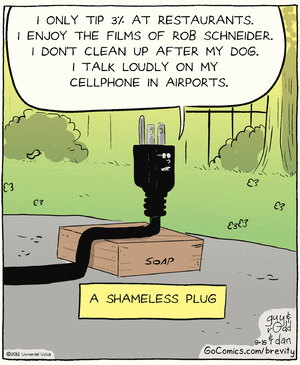
And that's how it is for the first Cartoon Saturday of the last month before the election. Think of it as my way of helping keep something of a smile on your face as you grit your teeth and try to ignore the flood of robo-calls, distorted statistics, shameless spin, and outright falsehoods that pave the way to November 6th.

I'm here for you.

Have a good day. More thoughts tomorrow.

Bilbo

Friday, October 05, 2012

They're Back!!!!


Yes, Dear Readers, Agnes and I have returned from our nearly-three-week extravaganza of travel, relaxation, sightseeing, relaxation, overeating, relaxation, and ... did I mention the relaxation part? I should be able to go back to work next week and be happy, cheerful, and productive for at least ... oh ... twenty minutes or so before getting all sour and pissed off again!

But now we're back and adjusting to the realities of everyday life ... nobody to make the bed and put little chocolates on it for you ... nobody to seat you at the dinner table and put the napkin in your lap ... and this washing your own dishes thing is a drag, too. Sigh.

But anyhow, we are back and we had a wonderful time. Between us we took over 2,000 pictures*, but you won't have to look at all of them. Here are a few samples ... those of you who want to see more can check my Facebook page in a day or so, and I'll put up a larger album.

We started our vacation in Los Angeles with a visit to our son Matt, who works for the LA County Museum system. We visited the Page Museum at the La Brea Tar Pits, which is a lot more interesting than it sounds ... you don't just get to see bubbling tar ...


You might also get to be only the fourth person in more than 40,000 years to handle the left rear thigh bone of a dire wolf (canis diris) who met his unhappy end stuck in the ancient tar ...


Agnes also took a picture of Matt and I with a giant ground sloth in the park outside the museum. We'll be revisiting the subject of sloths on Sunday, when we get to the part about our visit to Cartagena, Colombia ...


On Thursday, September 20th, we boarded the good ship Coral Princess and set sail for the Panama Canal and nearby places.

Our first stop after five relaxing days at sea was Puntarenas, Costa Rica. We took a tour to the Tabacon thermal spa located at the base of the Arenal Volcano, three and a half hours by bus from Puntarenas over very narrow, very twisting, largely very poor roads. The volcano was shrouded in low clouds as we piled off the bus and immediately changed clothes to dive into the hot springs, which were beautiful and very relaxing, consisting of a series of pools and waterfalls threading through the dense rain forest ...


Many of the pools featured benches on which we could sit while the hot water poured down over us. Agnes found it to be very soothing ...


We even got to see one of the resort guests lounging by the pool, stark naked ...


By the time we left the spa after the too-short visit, the clouds had mostly cleared and we were able to see the beautiful and imposing Arenal Volcano ...


... before boarding the bus for the 3-1/2 hour drive back to the port by way of a "butterfly farm" whose butterflies were all, alas, asleep by the time we arrived in the rainy gloom of the late afternoon.

After another day at sea, we arrived at Fuerta Amador, Panama, for a short visit before beginning the transit of the canal. At Fuerta Amador, we visited the Soberania Baru National Park and the Gamboa Rain Forest Resort, where we rode an aerial tram up through the rain forest canopy ...


to a 30 meter-high observation tower ...


from which we had broad views out over the Panamanian rain forest and a large section of the central (Gatun Lake) portion of the Panama Canal.


Although the park and the associated rain forest is said to be home to hundreds of species of birds and animals, the largest thing we saw (other than a lonely iguana sunning himself at the side of the road) was the ubiquitous termites and ants that seemed to infest every other tree ...


After the tram ride, we had an hour or so to see other displays in the Gamboa Rain Forest Resort, including a display of tropical fish and reptiles, a "serpentarium," a butterfly farm (there are butterfly farms all over the place in Central America ... I think it's a legal requirement), and an orchid garden. All interesting, but not as exciting as the tram ride. We ended up back at the port and had lunch at a local restaurant before riding the tender back out to the Coral Princess ...


The next day was our transit of the Panama Canal, which was about as fascinating an experience as I've ever had. We were scheduled to begin the transit at the first (Miraflores) set of locks at 7:00 AM (a bit early for a vacation day, but what can you do), and so I was up early, liberally smeared with sunblock and ready to see all the action ...


The upper decks of the ship were crowded with people who appeared to have been in place since midnight to get the best views of the transit. I went up to the highest open level on the ship (Deck 15), squeezed under the rails, and shot between the panels of colored safety glass in order to get my pictures. In this one, the Coral Princess is lining up to enter the left-hand side of the Pedro Miguel (second) locks on the Pacific side, as another ship passes out of the right-hand side ... you can see the gates of the lock starting to close on the right, and the difference in the depth of the water between the two sides. Once in the lock, the water would be pumped in to raise us to the next level so we could move into the next portion of the canal ...


Here, the level has been equalized, and the locks are starting to open so the Coral Princess can sail out ...


Actually, we never "sailed" through the locks ... the ship was so large that it had only a foot or so of clearance on each side, and so she was towed into and out of the locks by electric locomotives that pulled on cables attached to the ship. Here is what the towing operation actually looks like, as four locomotives pull a huge freighter through the lock opposite our ship ...


Once through the Miraflores and Pedro Miguel (Pacific side) locks, we passed through the Culebra Cut and into Gatun Lake, the giant freshwater lake that provides the water for the canal's operation, and in which ships often anchor to wait their turn to go through the locks. We learned that the largest ships, like the Coral Princess and the large freighters in the other pictures - because they are so large and have so little clearance on all sides of the locks - can only transit during the daylight hours for safety reasons, and so many smaller ships pass one set of locks during the night, then wait in Gatun Lake until the next night to complete their passage. Here is a picture of part of landscape along the Culebra Cut ...


And here is a view from Gatun Lake, looking out over a vintage 1855 road/railroad bridge toward the distant rain forest. If you enlarge the picture and look closely, right at the center, on the skyline just above the bridge, you can just make out the very top of the observation tower we climbed the day before ...


We passed through the last three (Gatun) locks at about 3:30 PM and sailed into the Bay of Limon and the Caribbean Sea ... we were now on the Atlantic side of Panama, having achieved in about nine hours a trip that would have taken months had we sailed around the southern tip of South America. A very exciting and very interesting day!

The following morning we pulled into our next port of call, Cartagena, Colombia ... but we'll talk about that in another post. No sense in letting you get bored with the travelogue.

Have a good day. More of our adventures coming on Sunday, after Cartoon Saturday makes its appearance tomorrow.

Bilbo

* Between a third and a half of them are probably pictures of clouds, sunrises/sunsets, and the ship's wake, because on a cruise with seven out of 14 days at sea, there isn't much else to take pictures of.