Showing posts with label A Polite Society. Show all posts

Tuesday, December 02, 2025

What Our Children Are Learning


This meme recently appeared on my Facebook feed:


I didn't know whether to be sad or angry, so I settled on both. And I figured I might as well add a few points the meme's author missed:

It's un-American to question the actions of your government. 
 
If you're strong and rich, laws don't apply to you; you can behave terribly and not suffer any consequences.

The truth is whatever you say it is, as long as you repeat it loud and long enough.

You can ignore inconvenient facts and manufacture your own as you need. 

I have three adult children, and six grandchildren ranging in age from 13 to 25. I hope that they continue to reject the despicable example set by this president and the members of his administration. And I hope that I never behave in a way that makes them think I would behave so terribly.

Have a good day. Believe in the Constitution and the law, not in the squalid and disgusting behavior of the current leadership.

More thoughts coming.

Bilbo

Tuesday, July 27, 2021

Abracadabra, Please and Thank You


Let me begin by clearly stating that I'm no saint. I have behaved badly from time to time, and have done things that, in retrospect, I am ashamed of. I always try to do well and live right, but I do occasionally fall off the wagon of good behavior.

Okay, now that that's out of the way, what the heck is wrong with people nowadays?

People of every age, religion (especially religion), color, and culture are behaving like total, self-absorbed, self-righteous idiots. Look at the world around us ...

Because Der Furor needed to blame his mismanagement of the Coronavirus pandemic on something other than his lack of leadership and common sense, he harped on the theme of a Chinese virus - the "kung flu." And what happened? Brainless morons assumed this meant it was okay to assault elderly oriental people on the street, because their fearless leader gave them license to do it.

We might have beaten the pandemic with the vaccines developed in record time by dedicated scientists ... but because so many people have been conditioned to believe that their personal freedoms and desires are more important that the lives and safety of those around them, and because there are politicians to whom their power and agenda are more important than the lives of their constituents, more than 610,000 Americans are dead, and the number continues to climb in states where rights and freedoms are more important than the common good.

"Karens" and "Kevins" (the male equivalent) feel empowered to launch their fears and prejudices like weapons at any time and place, making them look like spoiled and undisciplined children.

The absolute right to unrestricted ownership of guns has led to terrible carnage on our streets, but because the Second Amendment is more important than the preservation of life, there is no chance of rational thought or discussion of ways to minimize the danger.

People treat each other badly in general because they see their leaders behaving badly without consequences. Remember that video of Der Furor shoving the Prime Minister of Montenegro out of the way so he could preen at the center of a group photo? And look at the behavior of fools like Marjorie Taylor Greene, Jim Jordan, and Ted Cruz. Is this how we want our children to behave?

My parents always stressed the importance of good behavior and acceptance of responsibility for our actions. They were unfailingly polite and generous and expected us to be the same. Their philosophy was that we should always behave well toward others until they give us reason to do otherwise ... then you have room to launch back. I've tried to follow their example by trying to be slow to anger, but more than willing to make it worth someone's while if they push me to it.

I remember seeing a movie long ago in which a character commented that there were two kinds of people in the world - diplomats and door mats - and that you didn't have to be both. The message was that you could be polite and diplomatic without letting everyone walk over you. It's a good thing to remember nowadays, when it seems that many people equate politeness and good manners with weakness and submission.

On his TV program for young children, Captain Kangaroo often invoked his magic words - "Abracadabra, Please, and Thank You" - as a way of teaching young children the importance of being polite. Where's the Captain now, when we need someone to model good behavior?

This has been a sort of stream-of-consciousness post*, but right now I'm being bothered by the miserable behavior of most Americans and don't know what to make of it. If you see me acting badly, you have my permission to give Calvin a dollar on my behalf ...


Have a good day. More thoughts coming.

Bilbo

* I hope it made more sense than one of Der Furor's stream-of-unconsciousness rally speeches, if nothing else.

Thursday, July 12, 2018

Derangement Syndrome


If you are one of my many friends on Facebook, you may already have seen all or part of what follows ... feel free to stop reading and come back another day. Otherwise, feel free to read on and to leave civil and thoughtful comments. I will summarily delete any comments that involve name-calling or fail to clearly and cogently address the issues raised here.

A while back, I engaged in a long-running online debate with one of my old co-workers, a person whose opinions I respect although we fundamentally disagree on many political issues. At one point early on in the discussion, he admonished me for exhibiting "TDS" ... "Trump Derangement Syndrome."

Derangement Syndrome is not a new thing in American political life. I first heard the term used during the administration of the second President Bush, when Republicans and conservatives accused Democrats and liberals of "Bush Derangement Syndrome" - an inflexible opposition to everything said or done by George W. Bush. Derangement Syndrome returned in its mirror image a few years later when it morphed into "Obama Derangement Syndrome," an inflexible opposition to everything said or done by Barack Obama ... including the absolute conviction (against all evidence) that Mr Obama was not born in the United States and was thus ineligible even to be president. Obama Derangement Syndrome was particularly virulent because it was laid over an ugly layer of racism that bubbled beneath the more or less calm surface of American life.

And now, of course, comes the third mutation of the condition - "Trump Derangement Syndrome," an inflexible opposition to everything said or done by Donald Trump*.

Disclaimer: I frankly admit that I despise Donald Trump. I didn't like Hillary Clinton either, but Trump to me represents the worst in American politics - a man without scruples, with no knowledge or understanding of significant issues of domestic or foreign policy or international economics; a man utterly unfamiliar with and dismissive of Constitutional norms; a shameless liar even when lying was unnecessary and who, when his lies are exposed, simply doubles down on them; a man willing to hurl juvenile insults at opponents; a man who blithely alienates our closest allies and cozies up to the worst dictators; and a man willing to utter the worst sort of banana republic-style threats of violence and legal action against his opponents.

If being horrified by this constitutes TDS, then I guess I'm guilty as charged. But despite my friend's urging to respect the office of the presidency if not the incumbent, I cannot accept the debasement of the office once held by George Washington, one of the most civil and thoughtful of men, by a man who completely lacks the common decency, civility, and gravitas required by the nation's highest office ... once the most powerful position in the world. I cannot support or admire a man who does not accept that he is the president of all Americans, with a responsibility to unite the country (difficult though the job may be) ... not just to pander to those who wear red hats and cheer his every word at his endless ego-trip rallies.

One can make the specious argument that Trump supporters felt the same way about life under President Obama, but then, Obama did not blatantly lie at every turn, constantly ridicule his opponents, declare the press to be the enemy of the people, call for his electoral opponent to be jailed, insult and ignore the warnings of his own intelligence community, and deliberately insult our closest allies while embracing autocrats who represent the opposite of traditional America values.

My friend says that he doesn't like everything Trump says, but he likes what he does, and he urges me to recognize the positive things Trump has accomplished, but I don't see any. As far as I can see, the much-ballyhooed tax has resulted in my taxes going up. Our traditional alliances are in tatters. North Korea, having vaguely sort of halfway maybe promised to stop its nuclear program, has been caught secretly upgrading its facilities and has blithely insulted Secretary of State Pompeo with the accusation that the United States is engaging in "gangster politics" ... a turn of events anyone with any knowledge of previous negotiations with North Korea could have foreseen. We have unnecessarily antagonized the rest of the world and gotten ourselves into a trade war that others will be happy to help us lose. While we desperately need a complete revision and update of our immigration policy, we have squandered our moral high ground by engaging in horrifying acts of brutality unworthy of a great nation. I am probably the only person who has actually put forward a potentially-workable plan for immigration reform ... but nobody's interested.

If opposing - on firm and defensible grounds - the sort of man we've placed in office constitutes derangement, then I'm deranged. But I'd rather be considered deranged by some than sit back and watch the country I love go down the drain. There is no ... no excuse for the sort of behavior demonstrated by Donald Trump and his cronies and enablers**. Someday ... sooner rather than later, I hope ... we will realize what we've done and right the ship.

But I'm afraid its already too late.

Have a good day. Demand better of your government, even if there's little hope of getting it.

More thoughts coming.

Bilbo

* There's also a Hillary Derangement Syndrome which is every bit as virulent as Trump Derangement Syndrome, but it doesn't really count in this discussion because she was not elected (according to law and the Constitution, if not the popular vote) and has no measurable influence in government any more.

** Yes, I know that I will be excoriated by those suffering from whataboutitis, angry because I have not equally castigated Those Damn Democrats who, everybody knows, started the whole thing. Maxine Waters is as big an idiot as Donald Trump, but is not in a position to cause as much lasting damage to the nation as Trump is. 

Wednesday, April 04, 2018

Things We Don't Learn Any More


When I was growing up, my parents insisted that we show respect and good manners. They set the example, and expected us to follow it.

Nowadays, I don't think that there are many parents who themselves know how to show respect and good manners, and many of them certainly aren't passing them on to their children. Among the lessons they aren't passing on are the ones noted in this article I found yesterday -10 Things That Used To Be Basic Manners That Kids Today Have Never Learned ... with my commentary, of course ...

1. Basic words of courtesy. Words like "please," "thank you," and "you're welcome" are in short supply nowadays, and even pleasant greetings like "good morning" and "good evening" don't often make an appearance. Being pleasant and respectful toward people evidently diminishes one's "street cred," or creates a sense of putting oneself in a subordinate position to others.

2. Taking care of your appearance. I can't imagine what sort of impression some people want to make when they have their pants hanging halfway down their backsides, or a baseball cap worn at a stupid angle. I don't put on a coat and tie to make a simple trip to the store, but I at least try not to look like Freddie the Freeloader when I go out.

3. Proper posture. I was always taught to stand up straight. Not only does it make a better impression, but it turned out to be very useful when I got into ballroom dancing, and my good frame (dance posture) helped compensate for my many footwork mistakes.

4. Sending handwritten thank-you notes. Most people don't even know cursive writing any more, so this one's not surprising. Sending a thank-you e-mail is more-or-less okay in today's technical world, but not sending a thank-you at all, or doing it by SMS, is pretty gauche.

5. Table manners. I'm sometimes guilty of putting my elbows on the table, but I do try to use the good table manners my parents taught me. It's pretty shocking to see how some people in restaurants comport themselves while they eat.

6. Rising when an older person enters the room. I was always taught that it was a sign of respect to stand up when an older person or a lady entered the room. You don't see that much any more, and I seldom see anyone stand up for a lady. This may be a function of our drive for gender equality in all things, but I still think it's sad.

7. Sitting with your ankles crossed. This one applies more to ladies, and I'm not sure that I agree that this is a problem any more ... or perhaps I just associate with ladies who have been raised in a more genteel home.

8. Taking off your hat indoors. Well, who wears hats any more, except for those idiots who wear cockeyed baseball caps? Just take it off, okay?

9. The woman decides when the night ends. It's always good when the lady gives a signal what she expects ... it can save a lot of agony and embarassment.

10. "Make an offer." I'd never heard of this one ... I was always taught that if I asked a lady out, I should expect to bear the cost of the date. Nothing wrong with "going Dutch," but I would never expect someone I'd asked out to offer to pay part of the cost. Maybe it's just me.

Are there any other lost signs of good manners that you have noticed? Leave a comment.

Have a good day, and use respect and good manners. It doesn't cost extra.

More thoughts tomorrow.

Bilbo

Monday, June 26, 2017

Thoughts on News, Anonymous Sources, and Leaked Information


One of the most overused adjectives in modern news reporting is anonymous. According to the Merriam-Webster online dictionary, it has three meanings:

1: of unknown authorship or origin (an anonymous tip);

2: not named or identified (an anonymous author; they wish to remain anonymous); and,

3: lacking individuality, distinction, or recognizability (the anonymous faces in the crowd).

For purposes of the present discussion, the first two definitions are of primary interest.

A cornerstone of modern news reporting is the so-called "anonymous source." Many news reports rely on the input of sources who wish not to be identified. Some reasons often given for this wish include:

 - "the source was not authorized to speak to the media;"

- "in order to speak about internal discussions;"

- "in order to discuss classified material;" and,

- "because the source feared reprisals for speaking to the media."

Although it pains me deeply to agree with Donald Trump on anything, I have to agree on the issue of anonymous sources, and the leaking of privileged information in general. As a rule, I don't like or trust anonymous sources, because they make me complicit** in advancing their personal agendas, with which I may not agree and which may not be as altruistic as they would have us believe. Further, leaked information lacks valuable context. And finally, I don't find the usual excuses to be very persuasive:

If the source "was not authorized to speak to the media" but did so anyhow, what was his** reasoning? "Not authorized" to me means "not authorized," not "not authorized unless you think you know better than everybody else."

If the source provided privileged information "in order to speak about internal discussions," why were the discussions privileged and internal in the first place, and why did the source believe she had a right to expose them?

If the source provided privileged information anonymously "in order to discuss classified material," he needs to go to jail. We live in a world in which clueless idiots who have drunk the government-is-always-evil Kool Aid automatically equate "classified" with "juicy evidence of government wrongdoing." Most of the time, "classified" material is "classified" in order to protect the way in which it was collected, and to keep enemies from knowing we have collected it. Sanctimonious leakers who think they know better can imperil our capabilities and, in the worst case, cost lives. There are legitimate avenues for people with concerns to raise them within intelligence channels*** ... holier-than-thou showboaters belong in jail.

Finally, if the source provided privileged information anonymously "because she feared reprisals for speaking to the media," well, perhaps that source ought to be afraid, because she has violated the trust placed in her when access to the information was granted.

The number of news stories that rely exclusively on anonymous sources nowadays is huge, and likely to get larger. The problem for you and I as consumers and evaluators of news is that we do not know the source's motivation, nor do we know the context in which the source obtained the information he has released. Even worse, I think, is a news story that relies on multiple sources, all of whom want to remain anonymous. Does the fact that more than one anonymous source reports the same thing give more credence to the information? How do we know that they are not colluding† with each other? Whom do you trust?

The reliance on anonymous sources places us in the situation of having to rely on the judgement of reporters - who may have their own political agendas or be driven by the competitive speed of the 24-hour news - to decide on the veracity of the leaked information.

At a time when the President of the United States has only the most tenuous of relationships with the truth, and his spokespersons shamelessly churn out obvious and provable falsehoods; when the news media relies on sources of information we cannot see or evaluate; where do we the people get the information we need to evaluate how well our government is serving us?

Where, indeed?

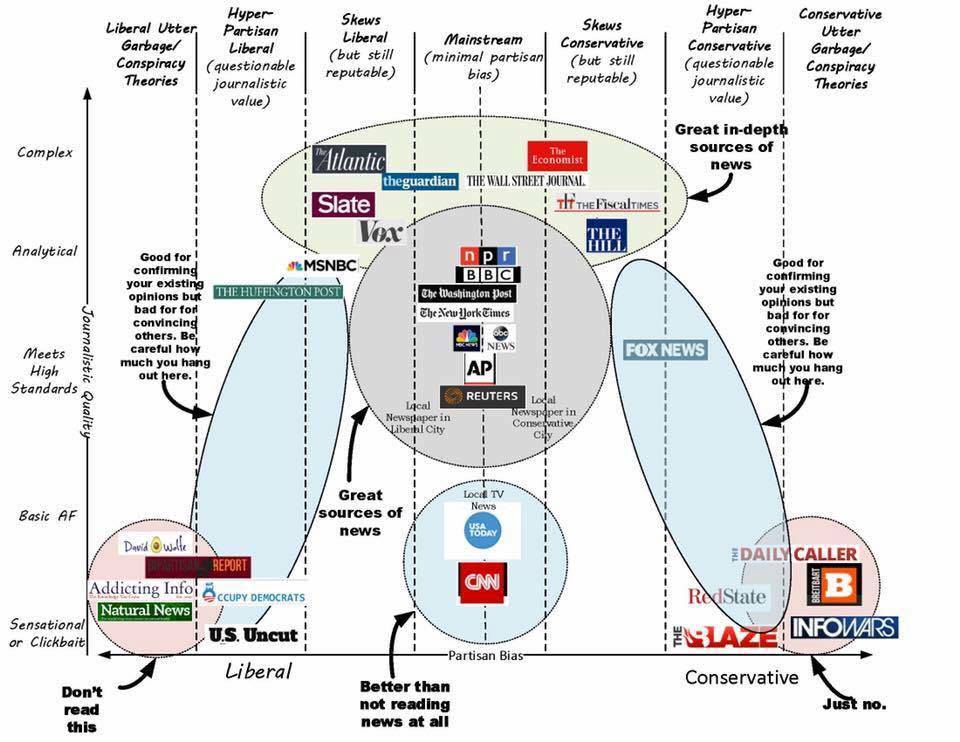
Have a good day. Listen critically and don't rely on single media outlets for your information. Some are better than others, but none deserves your complete and total attention and belief. Here's a useful chart that's about as "fair and balanced"†† as you're likely to find††† ...


More thoughts tomorrow.

Bilbo

* A useful Trump-era word.

** For the sake of simplicity, from here on out, when I use the pronouns "he," "she," "him," "her," or "his," you should understand that I mean "he or she," "him or her," and "his or her." I don't want to sound "sexist," but I also don't want the writing to be cumbersome.

*** I have used them myself.

† Another useful Trump-era word.

†† Did you notice that Faux News has quietly dropped that slogan?

††† Although I can hear the howls of outrage from both ends of the spectrum already.

Friday, May 26, 2017

Beyond Disgust


The day before a special congressional election in Montana, GOP candidate Greg Gianforte, enraged by questions posed by a reporter that he didn't want to answer, physically assaulted the reporter, slamming him to the ground, breaking his glasses, and screaming that he (the reporter) should "get the hell out of here." Gianforte's spokesman spun the incident this way in a statement released later:

"It's unfortunate that this aggressive behavior from a liberal journalist created this scene at our campaign volunteer BBQ."

In the election the next day, Gianforte was elected by a comfortable margin.

Think about that for a minute: a man who who believes he should be elected to Congress physically assaulted a reporter doing his job. And the next day, a majority of the people of Montana decided that was okay.

This is the oath of office that members of the House of Representatives take* when assuming their positions:

“I, (name of Member), do solemnly swear (or affirm) that I will support and defend the Constitution of the United States against all enemies, foreign and domestic; that I will bear true faith and allegiance to the same; that I take this obligation freely, without any mental reservation or purpose of evasion; and that I will well and faithfully discharge the duties of the office on which I am about to enter. So help me God.” 

Mr Gianforte, his spokesman, and everyone who voted for him seems to have forgotten that freedom of the press is part of the Constitution he is supposed to support and defend ... but although everyone shouts about the Constitution, few actually read it, or understand that there are freedoms it enshrines other than the right to pack iron everywhere, for any reason. 

What Mr Gianforte did was beyond despicable. The statement issued by his spokesman which heaped blame on the victim was equally despicable and should have appalled anyone who seriously believes in the rights established under the Constitution. Things are bad enough when Donald Trump heaps verbal abuse on those he claims convey "fake news" - defined as that with which he disagrees. They've grown far worse when an elected official believes he can - without consequences - physically assault a reporter in front of a room full of witnesses.

This is not the country I loved and served in my Air Force career.

Bilbo

* Spelled out in law at 5 U.S.C. §3331.

Monday, November 21, 2016

Unfriending


If you spend much time on Facebook, you have probably seen this recent post that has been making the rounds -


Given the reaction by some of my friends to some of the things I've posted, and my reaction to some of the things some of my friends have posted, I thought it was brilliant, and promptly published it on my own FB page. I received a number of comments, many of which concerned the number of people that are now being "unfriended" because of irreconcilable political differences.

This is sad.

Within my circle of friends, I have conservatives, libertarians, liberals, gays, lesbians, Christians, Jews, Muslims, atheists, agnostics, immigrants (including the legal, taxpaying one to whom I'm married), Blacks, Whites, Asians, Hispanics, and all sorts of permutations and combinations thereof. So far, I haven't unfriended anyone because of their political views, religious beliefs, sexual orientations, or racial background. 

That's not to say that I won't unfriend anyone in the future. My general philosophy of life to like everybody until they give me some really good reason to not like them. What this means is that I have a lot of friends with whom I don't agree on all topics, but we get along anyhow. There are, of course, people I don't like - among them liberals, conservatives, libertarians, Blacks, Whites, Hispanics, Asians, Christians, Jews, Muslims, gays, lesbians, atheists, agnostics, and immigrants - but the reason I don't like them isn't because they're Black or White or Hispanic or Asian or liberal or conservative or libertarian or Christian or Jewish or Muslim or gay or lesbian or atheistic or agnostic or come from some other country - it's usually because they're either trying to force their beliefs on me or doing something that is blatantly illegal*. 

So here's the deal ...

I'm going to keep writing this blog and expressing my opinions, which is my right under the First Amendment to the Constitution**. You are free to read or not read, as you wish. I encourage you to argue with me, and to call me out if you think I'm wrong. This is a democracy, in which we share thoughts and viewpoints in the marketplace of ideas. If you think I'm wrong, though, I expect the courtesy of a counterargument that relies on genuine facts ... not ad hominem comments or snide remarks or allusions to unproven events or clickbait articles from Breitbart.com or an equivalent left-wing website. I expect a genuine effort to understand my point of view, as I'll try to understand yours. In today's superheated environment, it's unlikely that our respective opinions will change overnight, but at least we ought to be willing to consider the validity of different points of view based on evidence, and not on the political prism through which we view them.

If you can't do that, you may end up ... well ... unfriended ...


Have a good day. More thoughts tomorrow.

Bilbo

* Like coming to this country illegally and expecting everyone to think it's okay.

** Amazingly enough, there are rights guaranteed by amendments to the Constitution other than the Second.

Thursday, July 21, 2016

What Constitutes A Polite Society?


You've almost certainly heard this famous quote from the story "Beyond This Horizon" by science fiction author Ray Bradbury ...

"An armed society is a polite society. Manners are good when one may have to back up his acts with his life."

There's been some discussion over exactly what Bradbury meant to say with this line in the context of the story, but there's no doubt at all that it is taken at face value by present-day gun rights advocates, particularly those who support the right to carry firearms, openly or concealed, at all times and in all places. In a 2000 essay titled "Armed Citizens are Responsible Citizens," William Levinson wrote,

     "The common perception is that armed societies were polite because an act of rudeness might evolve into a duel, as portrayed in Dumas' The Three Musketeers. The real reason, though, is the mindset and psychology that come with responsible weapon ownership [emphasis in the original]. The knight's sword was a symbol of his duty to protect weaker members of society and behave chivalrously, e.g. with respect and courtesy to women, elderly people, and so on. The sword was the soul of the Japanese samurai, a constant reminder of the samurai's duty and code of behavior. The sword was a symbol of taking responsibility, not only for one's self, but usually for others. 
     "The modern American who buys a firearm for self-protection is saying, "I recognize that life involves danger, and by owning a weapon I accept my responsibility to protect myself and those who are entitled to my protection-- my wife/husband, children, parents, and perhaps friends and neighbors."

The events of the last few weeks lead me to question Mr Levinson's concept of "the mindset and psychology that come with responsible gun ownership" because responsibility is something that nowadays plays second fiddle to freedom. I would argue that it is not responsible to openly carry a weapon into a volatile situation where violence might break out at any time ... the responsible thing to do would be to avoid such a situation if at all possible, or at least to not take actions that might make it worse. Comparing an open-carry advocate to a chivalrous knight or a samurai seems a bit of a stretch.

Obviously, advocates of gun ownership and ostentatious open carry would disagree.

But the issue is, to me, not one of whether or not packing heat everywhere is a good idea ... although I don't think it is. The issue is what makes a society polite.

I grew up in a time in which people in general were much more polite and respectful toward one another than they are today. My parents and the parents of most of my friends placed a great deal of emphasis on personal probity and good manners, and raised us to do the same. Nowadays, it seems that civility and good manners are considered marks of weakness. You don't build "street cred" by being polite ... you build it by getting in everyone's face. One need only look at the behavior of Donald Trump to see how low our standards of personal decorum have dropped.

In his 1998 book Civility: Manners, Morals, and the Etiquette of Democracy, Stephen L. Carter wrote that

"Civility requires that we express ourselves in ways that demonstrate our respect for others."

 Good luck finding that civility in the current overheated presidential campaign, where respectful and polite discourse vanished long ago. We are preparing to choose a president based on our relative evaluation of the brutal ad hominem attacks that have taken the place of detailed discussion of important issues of policy.

In a polite society, people strongly disagree with each other, but treat each other with dignity and respect. We can dislike the ideas but be civil toward the person expressing them. No more.

I have been accused of hypocrisy on this topic because, while advocating civility and politeness, I present my Ass Clown awards in this blog. While my intent is not mean-spirited, the presentation of such an award isn't especially civil, and perhaps I should work toward morphing those awards into something more satirically pointed and less vulgar. I guess I'll work on that.

But to get back to my original point, from which I think I've wandered ... let me just wrap this up by suggesting that if we need to pack heat to enforce politeness, we're screwed. We just need to treat each other better. We need people to show that they're of a better ... caliber.


Have a good day. See you tomorrow for our second July iteration of Great Moments in Editing and Signage. More thoughts then.

Bilbo

Tuesday, April 26, 2016

And This Little Piggy Cried "Me, Me, Me!" All the Way Home


There was an interesting article in the Washington Post last week: Nine Things About the Tokyo Subway That Will Drive Washington Commuters Crazy.

For those of us used to the hit-or-miss, will-it-come-or-won't-it, hope-I-don't-get-robbed-or-murdered excitement of riding the DC Metro, the concept of trains that are clean and run on time is a novel one. But what makes Tokyo's trains a lot nicer than Washington's has to do with people and their behavior. Of the nine things the article discusses about the Tokyo subway, three in particular stand out:

#2: It's Totally Orderly. In Japan, people line up and wait for people to exit the train before trying to board. In DC, it's everyone for himself/herself in a mad scrum when the doors open ... God forbid someone should make way for anyone else or avoid blocking the doors.

#3: It's Super Clean. Japanese people take their trash with them and put it in proper receptacles. In DC, commuters dump their trash wherever they want, assuming that it's someone else's job to clean it up.

#6: No Noise Pollution. Japanese trains are quiet because people use earphones with their music, and do not feel compelled to carry on loud conversations on their cell phones. In DC, everyone believes they are surrounded by a cone of silence that keeps everyone else from hearing the story of their last date, their medical problems, and their dinner plans.

This reflects how today's Americans see the world. The average American tends to value individual freedom above all else, often at the expense of recognizing any responsibilities to the larger society of which he is a part. An example is the furor over "open carry" laws in many states, where those who reject any limits on their Second Amendment right to bear arms do not care about the chilling effect their actions might have on those who take a more nuanced view of public armament, and who can't tell whether that fellow walking down the street with a loaded AR-15 is a "good guy with a gun" or a "bad guy with a gun."

We object to the "Nanny State" issuing laws we believe inhibit our individual rights. What business is of the government whether I wear a helmet to ride a motorcycle? If I want to smoke anyplace, why shouldn't I be allowed to? The Second Amendment says my right to keep and bear arms won't be infringed, so back the hell off with your limits.

We tend always to think of rights and freedoms, and not of responsibilities. I don't particularly care if you wear a motorcycle helmet or not, but if you get injured and require hugely expensive medical care you can't afford, it becomes my problem when my medical costs go up to cover your freedom. I don't care if you smoke, but I do care if my health is endangered when you do it ... you don't need to smoke, but I need to breathe. And we won't discuss the gun issue any more, because there's no point.

Clean subways that run on time and are peaceful and orderly are nice. People who take the time to think about the effect of their actions on others are nice, too.

But you don't find many of them here.

Have a good day. Remember the Golden Rule*. More thoughts tomorrow.

Bilbo

* For those who may have forgotten, it is "Do unto others as you would have them do unto you." It is not "Screw you, I'm doing what I want."

Tuesday, September 29, 2015

Use Your Words. Politely, Please.


Because I have impressionable grandchildren out there ...


Or, as they say in Virginia Beach during Spring Week ...


Thank you.

Have a good day. More thoughts ... with appropriate language ... then.

Bilbo

Thursday, September 17, 2015

Modern Telephone Etiquette


We all have stories about bizarre behavior exhibited by people using their cell phones in public. I've written here about the clueless traveler who broadcast his credit card number to a subway car full of people while booking a hotel reservation, the dumbass who shared with all of us in the airport gate area his argument with his proctologist's appointment clerk, and the cone of silence some people seem to think descends around them when they carry on highly personal calls from a stall in the men's room ...


But what are the new rules of etiquette that govern use of cell phones in public? I don't know that they've been written down anywhere a la Emily Post, allowing people to do pretty much whatever they want in public. After all, we seem to live in a time of extreme self-centeredness, where one can do whatever one wants, and those who object are the ones with the problem.

So ...

What are Bilbo's recommended rules for modern telephone etiquette? Here are a few:

1. If it's personal, keep it personal. The rest of us don't care about the fight you're having with your spouse. Save the argument for later when you can have it in the privacy of your home.

2. We don't need to know your medical history or the details of your business. Really. If you want to discuss that mysterious lump with your doctor, tell your significant other how your prostate exam turned out, or show the world what a big wheel you are, wait and do it in private ...


3. Don't shout. Yes, we know that cell phone connections aren't always the best, but we don't need you bellowing into our ears so you can have that conversation that absolutely can't wait.

4. Don't ignore the person in front of you to answer a call, unless it's an emergency. This is just plain good manners. Interrupting a live conversation to take a call tells the person you are talking to that they're not as important as the call you need to answer.

And since telephones aren't just telephones any more, there are a few other rules of etiquette that also apply ...

5. If you are with someone, leave the phone alone. Checking Facebook, Twitter, or your e-mail every two minutes, or playing an online game tells your partner they're not important to you ...


6. Selfies are not always necessary or desired. If you want to take your picture with someone, ask their permission before whipping out the phone to shoot the photo. And remember that it's not always appropriate to take selfies everywhere ...


7. Speaking of taking pictures, don't take anyone's picture without their permission. You wouldn't do it with your big 35mm SLR camera, so don't do it with your phone.

8. And one last word about photography: if you come into an emergency situation, help the people in trouble before you take the picture or shoot the video for the local TV station. I'd like to think this is common sense, but we all know that common sense is less common than it used to be.

For more about how telephone etiquette is changing, you can read this short article by Adrienne LaFrance.

Have a good day, but don't call me from a public place to tell me how good it is. And don't call me after 8:00PM, either.

More thoughts tomorrow.

Bilbo

Wednesday, August 26, 2015

The Things We Expect, and the Things We Don't


An interesting thing happened to me the other day.

I had gone into a local book store to buy some books for my granddaughter*. After leaving the bookstore I ran a few more errands, and arrived home an hour or so later. On unpacking the bag from the bookstore, I discovered that the clerk had put into the bag not only my receipt, but also the charge slip I'd signed.

I had to go out again later for something else, so I drove back to the bookstore and went to customer service to give them the signed charge slip.

Well ...

They were shocked that I'd brought it back. The look on the clerk's face was one of amazement, as was that on the face of the manager who came out in response to her summons ... she fell all over herself thanking me for bringing it back. As I walked away, I could hear them still chattering and expressing surprise that I'd actually brought back the charge slip.

So, here's my question: when did we start being amazed by someone who tries to do the Right Thing? Have we become so used to poor, selfish behavior, with everyone looking out for Number One, that the Right Thing actually shocks us?

Now, I'm not trying to portray myself as a paragon of good behavior, but I do try to live the values of honesty and fair play that my parents taught us, and to pass them on to my children and grandchildren. It's not always easy, but if we don't do it ourselves, how can we expect good behavior of others ... especially our political class?

Have a good day. Do the right thing.

More thoughts tomorrow.

Bilbo

* The Day the Crayons Quit, The Day the Crayons Came Home, and The Book with No Pictures.

Wednesday, August 05, 2015

Religious Freedom


This little meme has been making the rounds on Facebook ...


I think it's pretty accurate.

It seems as if nowadays many people's religious beliefs serve less as a guide to an upright and moral personal life than as a cudgel with which to beat those who express a different set of beliefs, or no beliefs at all:

Conservative Christians try to impose on everyone else a muscular Christianity they believe (falsely, as it happens) was written into the Constitution;

Aggressive atheists feel the need to loudly show their disdain for the deeply-felt beliefs of others;

Radical Muslims believe it's their duty to kill those who don't worship as they do;

Some Ultra-Orthodox Jews make life miserable for others by demanding accommodation of their insistence on strict separation of the sexes, to the great embarrassment and inconvenience of everyone else;

And every one of them absolutely, positively believes - beyond all doubt, reason, and compassion - that they, and only they, are right.

Perhaps if we just went back to the Golden Rule, things would be a lot better ... but I think that train sailed long ago.


Have a good day. Live your own life ... the rest of us can take care of our own.

More thoughts tomorrow.

Bilbo

Thursday, April 23, 2015

A Modern Template for Manners


I've been pretty cranky lately about the lack of good manners in my environment. I was raised by parents who believed strongly in good behavior and good manners ... my father was the kindest and most polite of men, and when he passed away earlier this year one of the most common comments made by those who came to pay their respects was about how friendly and thoughtful he was. Mom was the same way and - for the most part - the lessons in courtesy and civility they taught have stuck and have served me well over the years. Sadly, that's not the case with many people nowadays.

I'm re-reading a little book by Lucinda Holdforth that I bought back in 2007 - Why Manners Matter: The Case for Civilized Manners in a Barbarous World. It's a short but very entertaining and thought-provoking book about why good manners are important, more today than perhaps ever before. One particularly interesting chapter contrasts manners (which come from within and help us to get along with others) and laws (which are externally imposed and force us to get along with each other ... when they're observed). Ms Holdforth makes the point that we have tens of thousands of pages of laws, with more being passed every year ... more than any sane human could possibly remember, much less obey. And what is the end result of those thousands and thousands of laws? A nation of scofflaws that ignores most of them.

Someone once observed that while the US Code has 54 "Titles" and innumerable parts, sections, subsections, paragraphs, subparagraphs, and clauses that run to many thousands of pages ... and yet God Himself* only needed Ten Commandments. Can we do better by coming up with a short template for good behavior? Something simple, easy to remember, and easy to follow?

Ms Holdforth offers this modern template for manners that is simple, yet relatively comprehensive for use in daily life:

1. Keep to the left (or to the right, depending on jurisdiction);

2. Keep your word, especially about time;

3. Wait your turn;

4. Look after the weak;

5. Obey the laws and regulations, unless you are mounting a campaign of civil disobedience;

6. Watch what you are doing; multitasking is the enemy of manners;

7. Show appreciation for the kind gestures of others; and,

8. Most of the time, shut up.

That winnows down the Ten Commandments to eight simple guidelines. We can get even shorter if we could all agree to observe the Golden Rule: Do unto others as you would have them do unto you.

Do you have any suggestions for simple rules of good manners? Anything that people do thoughtlessly that grinds your gears? Leave a comment and let me know.


Have a good day. And be civil to one another ... it doesn't cost anything. More thoughts tomorrow.

Bilbo

* Or Herself, if you will.

Monday, March 30, 2015

In Praise of Offensive Language


Along with all the other rights that are guaranteed by our Constitution* is evidently a new one: the right not to be offended.

You have probably heard about the brouhaha over the Texas DMV's decision to disallow issue of a commemorative license plate bearing the Confederate battle flag - the "stars and bars" - because the agency's regulations permit it to “refuse to create a new specialty license plate if the design might be offensive to any member of the public” (the emphasis is mine). The case has gone all the way to the Supreme Court** for a decision on where limits may be placed on free speech when that speech might offend someone.

I happen to be a very strong believer in freedom of speech, and I've written about it in this space many times before ... most recently last month. I'm very concerned that we are allowing this most important of our freedoms*** to be chipped away not necessarily by government encroachment, but by a misguided desire to protect our collective feelings.

The best argument about the importance of our First Amendment right to free speech - even when it's offensive - was provided in a friends-of-the-court brief from the Cato Institute, among whose authors was the noted satirist and comedian P.J. O'Rourke. My old friend Ed, an attorney who has argued cases before the Missouri Supreme Court, turned me on to this brief, and now I want to share it with you. You can read the full text here (and you should), but if you have better things to do than thinking about about the importance of free speech, here are several of what I believe are the most important excerpts. I apologize for the lengthy citations of words other than my own, but they're important and I urge you to read them if you don't read the entire brief ...

"If this were simply another instance of governmental hypocrisy, we would not be here. There’s no constitutional provision forbidding hypocrisy, which Americans have come to expect from government officials. But Texas’s actions were more than merely hypocritical. They violated the basic constitutional principle—one that Texas had to reaffirm when it was readmitted to the Union—that a state cannot protect the sensibilities of some by restricting others’ freedom to speak."

"Such is the problem with trying to eradicate offensive speech: everything offends someone ... Texas’s law is not just unconstitutional, it is unwise. In a free society, offensive speech should not just be tolerated, its regular presence should be celebrated as a symbol of democratic health—however odorous the products of a democracy may be."

"... it is axiomatic that the First Amendment exists to protect unpopular, unusual, and controversial expression. Moreover, the protections traditionally offered to offensive speech are being slowly and dangerously eroded. The law challenged here imbues the DMV with stunning discretion, and it exemplifies how our increasing cultural timidity—a personal-political correctness—is turning into a frightening movement to suppress and eliminate “offensive” speech."

"A free society should not walk on eggshells, it should sleep on nails. Freedom produces barbs, points, and rough edges, and any attempt to sand those down will not only result in less freedom, it will create a less interesting, dynamic, and robust society."

"If no one ever offensively says 'the Emperor has no clothes' then a society may be condemned to dynasties of naked emperors, and that would be truly offensive."

"A society that protects its most sacred objects and beliefs from offense is one that will soon be ruled by naked emperors."

"We use barbed speech to undermine not just political dictators but the petty oppressors of everyday life: the tyrannical boss, the sanctimonious preacher, the blowhard at the bar, the neighborhood enforcer of stifling norms."

"Even more than 'mainstream' speech, offensive speech helps define us. Our commonalities do less to define our personalities than our eccentricities, offensive or otherwise. If speech is squelched by the government because it 'might be offensive to any member of the public,' then the government has closed off an important avenue for self-expression."

"Letting people define themselves through offensive expression also benefits others. It’s good to know who the offensive people are and, thus, who you’d like to avoid. Lukianoff, Unlearning Liberty, at 29 ('Prohibitions on hateful speech do nothing to stop hate, but they let resentment simmer, and they also prevent you from knowing who the hateful people even are.'). Exposed Nazis are better than hidden ones because most people would like to avoid associating with them. Similarly, if someone is offended by gun-rights supporters, pro-choice advocates, University of Texas fans, or, yes, Confederate sympathizers, allowing offensive people to speak can enhance the freedom of association."

"Attacks on free speech on college campuses, in particular the freedom to offend, have risen to the level of an epidemic. Students are being taught that 'real' freedom of speech necessitates censorship ... These speech-repressive campus regimes are not just harming students while on campus. Those students will become censorious voters, and 'offensive' speech’s days might be numbered. As Greg Lukianoff, the president of the Foundation for Individual Rights in Education has written: 'Administrators have been able to convince well-meaning students to accept outright censorship by creating the impression that freedom of speech is somehow the enemy of social progress. When students began leaving college with that lesson under their belts, it was only a matter of time before the cultivation of bad intellectual habits on campus started harming the dialogue of our entire country. The tactics and attitudes that shut down speech on campus are bleeding into larger society and wreaking havoc on the way we talk among ourselves.'"

"Unfortunately, speech codes are popping up in colleges and universities, the very places where speech should be 'uninhibited, robust, and wide open.' New York Times v. Sullivan, 376 U.S. 254, 270 (1964). And 'uninhibited, robust, and wide open' debate 'may well include vehement, caustic, and sometimes unpleasantly sharp attacks' on orthodoxies and received wisdoms."

The brief concludes with these words:

"It would be offensive to the First Amendment for this Court allow Texas to tell us what is offensive. After all, one man’s offensive speech is another’s exercise of social commentary or personal expression. This Court should affirm the judgment below and let putative offenders be judged in the court of public opinion."

As it happens, I am grievously offended by much of the stupid language coming out of the mouths of our political "leadership" lately. It may not contain individual offensive words**** per se, but it's profoundly offensive to me because it lacks evidence of such concepts as intelligence, forethought, compassion, and common sense.

Does this mean it should be outlawed? Using the formula of the Texas DMV, it should. And that's scary ... because if I can't hear our politicians being stupid, how do I know how to cast my vote?

Have a good day. Offend someone, even if it's me.

More thoughts tomorrow.

Bilbo

* And there are other ones besides the right to be armed to the teeth, believe it or not.

** Walker v. Texas Division, Sons of Confederate Veterans, docket #14-144.

*** Sorry, Second Amendment fans.

**** Such as those in the famous George Carlin routine "Seven Words You Can't Say on Television." Of course, nowadays not only can you actually say those words on television (at least on HBO and Showtime), but you can even hear them in places like preschools. Times change.

Tuesday, February 24, 2015

That's Mister Bilbo to You, Buddy!


As I get older, I find that more and more things irritate me, one of which is the idea of assumed informality. Here's an example ... a telemarketer calls the house, shilling for some product or service or religion or political party, and the call goes like this:

Bilbo: "Hello."

Anonymous Voice: "Is Bilbo there?"

Bilbo (in frosty tone): "This is Mister Bilbo speaking."

Anonymous Voice: (pause) "Uh ..."

I know that salespeople are trained to ingratiate themselves with customers, to establish a personal connection that will make it more difficult for the mark to say "no, thanks" when the inevitable pitch comes. This is why they'll start right off calling you by your first name. It's assumed informality, it's impolite, and it's wrong.

I think about this several times a week when I answer the unwanted calls that interrupt my free time*, and I noticed that I wasn't the only one offended by it when I saw this article in by Michael Strain in the Washington Post: Please Address Me as Mister. I Insist.

Mr Strain writes,

"Our society is suffering from a tyranny of informality. It is rude. It is false intimacy. It is a product of the utopian, egalitarian fiction that society is one big happy village. A friendship circle, where we’re all holding hands. Station and hierarchy should be leveled because they are so nineteenth-century. In the modern world, we are all equal — so we are all pals ... (but) ultimately, equality in all things is false. A PhD has added to the stock of human knowledge; an undergraduate hasn’t. A priest can transform bread and wine; a layman can’t. Chancellor Merkel can affect the near course of history; I can’t. My friend’s father has successfully raised four children; I haven’t. The way we address each other should reflect these differences because these differences are real and material, and obvious."

The privilege of calling someone by their first name ought to be something special. It ought to symbolize a degree of friendship and affection that has bridged the social distance between two individuals on a personal level. In many languages other than English, there are formal and informal modes of speech that indicate the social relationship between two individuals. In German, for example, one would always address a stranger or an older person with the formal pronoun Sie. Only family members and close friends to whom the privilege has been granted can use the informal pronoun du without giving insult. In English, we no longer have the formal/informal modes of address, having morphed down to the common you. But we have other ways to show social differences, one of which is the use of titles. When I retired from the Air Force, I was "Lieutenant Colonel Bilbo" to my military colleagues. Today, I'm just "Mister Bilbo." I would be offended if a child** or a stranger called me other than that until I had offered the use of my first name.

Mr Strain sums it up in his article thusly,

"If every relationship begins on a first-name basis, then I am robbed of the ability to signal to someone that he has become a friend or close colleague by inviting him to address me by my first name. If the guy who comes to fix my cable calls me 'Michael,' then what is left for my friends to call me? And isn’t it a little easier for the cable guy to give substandard service to 'Tom' than to 'Mr. Creal?'"

You, Dear Readers, can call me Bilbo. But everyone else ought to use "Mister" in front until I invite otherwise. It's the polite*** thing to do.

Have a good day. Save the honor of using your first name for those who earn it. More thoughts tomorrow.

Bilbo

* Despite the fact that we are registered on the national "Do Not Call List" which, I have come to realize, is pretty much useless.

** I don't mind my grandchildren's friends calling me "Mr Bill," but the use of my first name alone by a child is a non-starter.

*** Speaking of "polite," you might want to read some of the comments left online by people who read Mr Strain's article. Or not.

Wednesday, November 20, 2013

The Art of Conversation


Last Monday in this space we discussed the idea of lost skills - the things our grandparents were able to do that we today generally can't. It generated some interesting discussion in the comments and on Facebook and, as if it were a popular TV show, has led to a spinoff ... this post.

Number 11 on the list of lost skills was Socializing Like a Human, the idea being that not many people nowadays can carry on a conversation without the aid of some electronic device. In this context, my daughter had asked me a while back what I thought made someone a good conversationalist ... here's what I told her (augmented with what I should have told her but didn't think of at the time):

1. Be a good listener. Carrying on a conversation doesn't just mean being able to talk a lot ... it means being able to pick up on conversational cues and steer the discussion in mutually interesting and enjoyable directions. By paying attention to what your conversational partner says, you learn what he thinks is interesting and can keep the repartee fresh.

2. Read widely. Keeping up on current affairs always gives you something new to talk about.

3. Read things you don't agree with. One of the big problems we have nowadays is that people tend to only read or watch things that reflect their own interests and political, social, or religious preferences. This simply reinforces existing beliefs and keeps us from finding possible areas of agreement with others. If you find yourself in a heated discussion on some issue, having some degree of understanding of (if not agreement with) the beliefs of the other person helps you to keep the discussion on an intellectual level and minimize rancor.

4. Watch body language - yours and theirs. If you're talking with a person whose arms are crossed, eyes are wandering, or toes are nervously tapping the floor, you're probably losing their interest. By the same token, you should maintain an open posture and good eye contact to let the other person know that you are open to what they have to say and are focused on the discussion.

5. Know how to agreeably disagree*. Being a good conversationalist doesn't mean always doing the drinking duck, agreeing with everything the other person says. Feel free to disagree, but do it in a way that keeps the conversation going instead of slamming the door on it. Instead of saying something like, "How on earth could you possibly believe that horse hockey?", say something like, "I'm not sure I agree with that ... what makes you think so?" The first version tells the other person you don't agree and she's an idiot; the second tells her you don't agree, but offers her the opportunity to keep the conversation going by explaining the position. You may still disagree, but you've kept the conversation on a friendly basis. Here's a summary of good information about how to disagree.

6. Make the other person feel important. This builds on #1 and #4 above. If you're busy sending text messages, reading your e-mail, or watching what's going on around you instead of concentrating on the person with whom you're talking, you've told the other person that they aren't interesting enough to hold your attention, and you've killed the conversation. If you are talking with someone, put away the smart phone, maintain eye contact, and make him the focus of your full attention.

7. Have a few good, clean jokes in your hip pocket. Everybody loves to laugh, and a good joke can be used to break the ice, relieve tension, and keep everyone in a good humor. Steer away from jokes about topics which can easily give offense, like religion, politics, and ethnic stereotypes. Puns and silly observations are good, dirty limericks are usually a poor choice.

8. Know how to end the conversation. If you're in a casual conversation at a party or happy hour and want to move on to talk with someone else, don't just wander off. Let the other person know you've enjoyed talking with them and leave the door open for future contact. If you've learned something interesting, tell them; if you've disagreed, suggest that you may want to meet again another time to pursue the discussion. You want to leave the other person wanting to talk with you again.

It's going to be a while before we have this useful tool ...


... so it behooves us to master the vanishing art of good conversation.

Have a good day. Let's get together and talk about it sometime.

More thoughts tomorrow.

Bilbo

* For good examples of how not to disagree, read the comments posted to almost any online news story. Trolls are never good conversationalists.

Monday, May 27, 2013

Sorry, No Prince Charming Here, Just Move Along, Ma'am ...


If you remember your childhood fairy tales*, you will remember the story of Sleeping Beauty, who was saved from a curse by the kiss of Prince Charming. Well, it's a good thing she didn't live in 21st-century America, because we seem to have a serious shortage of charming princes. Or charming men in general, for that matter.

I ran across this very interesting article by Benjamin Schwartz in the Atlantic Monthly the other day: The Rise and Fall of Charm in American Men. Mr Schwartz maintains that modern America men lack the indefinable quality of charm that marked many great actors of the past like Cary Grant** and, more recently, James Garner and George Clooney. He writes,

"For nearly 20 years, any effort to link men and charm has inevitably led to [George] Clooney. Ask women or men to name a living, publicly recognized charming man, and 10 out of 10 will say Clooney. That there exists only one choice—and an aging one—proves that we live in a culture all but devoid of male charm."

What is charm, though? I think all women would recognize it, even if most men probably woudn't ... and wouldn't care. Mr Schwartz offers this partial analysis of charm ...

"It’s an attribute foreign to many [American] men because most are, for better and for worse, childlike. These days, it’s far more common among men over 70—probably owing to the era in which they reached maturity rather than to the mere fact of their advanced years. What used to be called good breeding is necessary (but not sufficient) for charm: no one can be charming who doesn’t draw out the overlooked, who doesn’t shift the spotlight onto others—who doesn’t, that is, possess those long-forgotten qualities of politesse and civilité. A great hostess perforce has charm ... but today this social virtue goes increasingly unrecognized. Still, charm is hardly selfless. All of these acts can be performed only by one at ease with himself yet also intensely conscious of himself and of his effect on others. And although it’s bound up with considerateness, it really has nothing to do with, and is in fact in some essential ways opposed to, goodness. Another word for the lightness of touch that charm requires in humor, conversation, and all other aspects of social relations is subtlety, which carries both admirable and dangerous connotations."

So why don't today's American men value the quality of charm?

I think it's probably because of the desire on the part of many men to return to a simpler, more basic America, to a time when "men were men and women were glad of it," a time before metrosexuals and thug culture, the imagined time of the rugged American individualism so beloved of the GOP. Modern American men are supposed to combine the best qualities of Paul Bunyan, John Wayne, and Sam Spade, and screw all this charm stuff. We live in a high-tech time when charm is an attribute of quarks, and not of men.

I like to think of myself as being charming, although I'm not sure everyone who knows me well would agree, at least all the time. As my Blogger profile says, I believe in courtesy (certainly an attribute of charm), common sense (very uncommon nowadays), and fair play (not always available in a country and a time when the degree of fairness available to one depends largely on the amount of money one can apply to its purchase). I try to apply the Golden Rule, to be polite (until given reason not to be), and to give people the benefit of the doubt before assuming guile or rank stupidity. Does this make me charming, or does it just reflect what I'd like to be able to experience from others? Who knows? Maybe a little of both.

I think we could use a little charm nowadays. Sadly, a little is all we're likely to get for the foreseeable future.

Have a good day. Try to be charming. It can't hurt.

More thoughts tomorrow.

Bilbo

* I mean, traditional fairy tales like "Cinderella," "Rumplestiltskin," and "Snow White and the Seven Dwarfs," not modern fairy tales like GOP economic theories and Democratic social idealism.

** When an interviewer once told him, "Everybody would like to be Cary Grant," Grant is said to have replied, "So would I!"  Another time, a reporter looking for accurate information for a story sent a telegram reading "How old Cary Grant?," to which Grant telegraphed back, "Old Cary Grant fine. How you?" I think I'd have liked this fellow.

Sunday, March 24, 2013

On Being Kind


You all know, of course, about the recent terrible events in Stubenville, Ohio, in which a drunken 16-year-old girl was raped by two members of the high school football team. The fact that the rape happened at all was bad enough, but no one associated with the crime smells very good ... from the young men who committed the rape to the other party-goers who filmed and photographed the crime and then discussed it on social media to the CNN reporter who filed a sympathetic story about the impact of the crime and the trial on the young criminals who violated a helpless girl.

Much has been written about the whole affair, from the mainstream media to the blogosphere (including this piece from Heidi), but I feel the need to weigh in on top of it all with my own observation ...

Just what kind of society have we become?

I was raised by parents who taught me good values and constantly drove home one basic lesson: the one we call The Golden Rule ... "do unto others as you would have them do unto you." It means we should all treat each other with dignity and respect and compassion, and to think of the impact of our actions on others before we barge ahead and do whatever we want.

Unfortunately, there's precious little of the Golden Rule to be seen nowadays. The emphasis today is on the rights and priviliges of the individual, and the hell with everybody else. Clueless dumbasses buy into a thug "culture" and try to build "street cred" through belligerence and an insistence on receiving the respect they are unwilling to give. Violent and misogynistic rap "music" glorifies crime, violence and the degradation of women.

In the world of politics and punditry, extremists of the far left and the far right shout past each other, tossing off ridiculous accusations and demeaning every word and action of those with whom they disagree ... perfectly willing to let the country go down the drain rather than make the least effort to seek common ground and move forward.

Ultrarighteous religious bigots of every sort, from radical Islamists to severe Christian fundamentalists to superultramegaorthodox Jews to the miserable hatemongers of the Westboro Baptist Church condemn - often with violence - those who dare to worship God in any but their own approved way.

What has happened to us? What lessons are today's parents teaching their children that lead to the Steubenvilles and the Sandy Creek Elementaries and other tragedies?


We have allowed ourselves to become a society in which personal rights and privileges are worshiped above responsibilities, compassion, and even common courtesy. The other day I read this wonderful article by Kim Simon: 4 Musts for Moms of Boys. In the article, Ms Simon talks about a question asked by another mother in a playgroup: “What quality do you want to instill in your child? What personality characteristic would you most like for your son to be known for?” Her answer was simple, but goes to the very heart of the problems we face today:

"I want my son to grow up to be kind."

That's what's missing ... we have lost the capacity to be kind to each other.

I have three children and six grandchildren I love deeply, and of whom I am enormously proud. And if there was one lesson I would try to teach them - hopefully, by example - it would be to observe the Golden Rule. To be kind.

The NRA and its apologists would have you believe that an armed society is a polite society, that we ensure our safety and earn respect by packing enough heat to intimidate and deter everyone else. This is stupid. A polite society is based not on the possession of weaponry and the willingness to use it, but on a sense of responsibility for one's actions and a recognition that the world works better when we treat each other with the dignity and respect we would like to receive in return.

Keep the gun if it makes you feel better. But try to simply be kind. It's a lot less expensive than an assault rifle, and you might find that you like it.

Have a good day. Observe the Golden Rule. More thoughts on Tuesday.

Bilbo

P.S. - You might also consider these worthwhile guidelines from George Washington's "Rules of Civility & Decent Behavior in Company and Conversation" -

#1: "Every action done in company ought to be with some sign of respect to those that are present;" and,

#69: "If two contend together take not the part of either unconstrained, and be not obstinate in your own opinion. In things indifferent be of the major side."

Smart guy, that George.

B.

Sunday, February 03, 2013

How We Talk to Each Other


Every once in a while (as you know if you've been with me for very long) I get an almost uncontrollable urge to capitalize on my parents' investment in my degree in Linguistics (which horrified my father, who had visions of a scientist or engineer in the family). I find language to be a fascinating topic, both as a vehicle for communication and as an indication of cultural development.

I thought about the latter aspect of language yesterday, when I read Angel's post titled "As American As ...", in which she riffed on some of the things we as Americans (sorry about that, Overseas Readers) have in common, as opposed to the many things which today divide us. One of the things she mentioned was that we are very good at profanity, which reminded me of this NPR story from earlier in the week: Dear Lawyers: Order In The &*%# Court!

You might think that lawyers, to whom precise use of language is critically important, and who often argue cases of great weight that may affect the lives of many people, would be judicious in their choice of words. But nowadays this is evidently not so, according to the NPR story which, in turn, cited a Wall Street Journal article about lawyers behaving like ill-mannered louts. From the WSJ article:

"From courtroom yelling matches to insulting letters and depositions that turn into fistfights, some lawyers and judges worry that the adversarial system of justice has gotten a little too adversarial ...
The well-mannered caution that lawyers who shout, lie and shoot off vulgar emails don't merely alienate judges and juries. They also slow the wheels of justice and cost clients money."


Ah, yes! If you can't get people to be civil any other way, appeal to economics.

It's not just lawyers, of course. As Angel points out in her post, "George Carlin's 'seven words you can't say on television'* is almost quaint."

I also found an interesting new expression this week on WordSpy: social swearing. The term is defined as "Casual swearing that helps to define and bind a social group." Yes, Dear Readers, we now have a term for the fact that we now routinely use - as a way of "bonding" - language my mother would have washed my mouth out with soap for using ... and that was before my father would have knocked me into the next zip code.

The indiscriminate use of foul language has grown tremendously since I was young. It's not unusual to hear grade-school children now using gutter language once associated with drunken sailors, longshoremen, rap "musicians," and uneducated ass clowns who don't know any better. It's all a part of the continuing coarsening of our society, in which The Golden Rule has changed from

Do unto others as you would have them do unto you.

to

Screw 'em.

We live in a time when many people who should know better have adopted the philosophy of the Robert E. Heinlein story Beyond This Horizon that 

An armed society is a polite society.

After all, why bother being polite and using calm and respectful langage when you can just pack heat to enforce granting of the respect you demand, but are unwilling to give in return?


I am, of course, not totally innocent of the use of less-than-scholarly language. I can turn the air blue with the best of them (in three languages!) when suitably provoked. But I try not to use profanity as a matter of routine, particularly not in front of small children or in a mixed company of strangers. I like to think of the use of profanity in the terms of a comment I heard and wrote down years ago. Sadly, I've lost the exact quote, but it goes something like this: 

"The English language has so few good cuss words that they should be kept stored away, protected and preserved against the time when no other word will do, at which time they should be unfurled and proudly waved like a flag of defiance in the face of an enemy who can understand no words more civil."

Take a few minutes to think about what you say and how you say it, particularly in front of children.


Perhaps you don't care whether you sound like an uneducated baboon, but I'd rather my grandchildren learn from a better example.

Have a good day. And have it politely. You may find you like it.

Bilbo

* Don't follow this link when small children are present near the computer, or if you are easily offended.