Showing posts with label Doing the Right Thing. Show all posts

Monday, February 24, 2025

Echelons Above Reality


Many years ago, during my last active duty tour as an Air Force lieutenant colonel in the Pentagon (shortly before the Air Force transitioned to single-wing aircraft), I ran an office that did long-range resource planning for intelligence systems. There were a great many times when we spent days or weeks painstakingly developing packages for approval by the senior leadership, only to have those carefully crafted plans shot down or sent back for revision by the generals, the senior civilians, or ... worst ... the lawyers*. We, of course, complained bitterly about this, raging that those people at echelons above reality didn't really understand that we knew better than they did.

Echelons Above Reality was the usual scornful description we applied to those whose jobs required them to look farther, deeper, and with more legal and political nuance than we did. They caused extra work for us, but it almost always resulted in plans that were more sound at all levels than our original products.

Which is why I was horrified to hear the Secretary of Defense of the United States of America denigrate our domestic and international legal responsibilities and the concerns of our (now former) allies as fluff of concern only at echelons above reality ... as annoying cobwebs to be brushed away as impediments to the only legitimate purpose of a military force: killing people and breaking things. 

Now, obviously, we live in a dangerous world, and there's no point in having a military that's not fearsomely lethal. It's like a pickup truck ... you don't need it very often**, but when you do need it, nothing else will do. But on the other hand, you probably want to know that that fearsomely lethal military operates under at least minimum constraints of legality and morality. There's a reason the framers of the Constitution placed the military under civilian control ... they'd lived the experience of having a king that turned his army loose on the citizens.

And now we have a president who actually fancies himself a king, and who had the staggering nerve to say so on the White House Twitter (X) account:


or perhaps "king" isn't quite good enough, as this depiction of Der Furor as an emperor a la Julius Caesar which appeared at last week's Conservative Political Action Conference may be more to his liking:


But it gets worse ...

This past Friday night**, Der Furor fired the Chairman of the Joint Chiefs of Staff, the Chief of Naval Operations, and the Vice Chief of Staff of the Air Force for the unforgivable crime of actually caring about the concerns of the men and women under their command. I don't expect someone who has denigrated those who lost their lives in the service of their country as "suckers and losers" to understand that real military leadership means letting those you may have to send to their deaths know that you care about them and their welfare.

At the same time, he fired the most senior Judge Advocates General (JAGs) of the Army, Navy, and Air Force ... the officials responsible for ensuring that the fearsomely lethal military Der Furor and Mr Hegseth want is run according to the law, inconvenient though it may be. These are the people who would explain posse comitatus to unhinged leaders who care only for the ability to wield raw power ... not for the legality and propriety of its employment. 

MAKE NO MISTAKE - THIS IS THE MOST FRIGHTENING AND DANGEROUS THING DER FUROR HAS YET DONE!

There aren't many supporters of Der Furor who read this blog, and so I have the unfortunate sense of preaching to the political choir. The MAGAts who follow the Orange Airhorn have their own sources of information, and will never acknowledge or understand the danger he poses until it affects them personally.

And then it's too late ... for them, and for the rest of us who saw it coming.

Have a good day. Do what you can to keep yourself informed and to help take back what's left of your country and its honor and dignity. More thoughts tomorrow, when we name the first out-of-cycle Ass Clown Special Award.

Bilbo

* There's no emoji to indicate dripping scorn, so just imagine it here.

** Unless you're in need of a powerful boost to your alpha male-ness.

*** He didn't even have the cojones to do it in the light of day.

Tuesday, February 11, 2025

The Pardon Power


Der Furor wasted no time in seizing the reins of power once he had been sworn in as the 47th President. He signed scores of royal decrees Executive Orders on a wide range of topics, many of them rescinding Executive Orders signed by previous presidents. He loves the trappings of power, and the imperial image of sitting at a desk with the cameras rolling, signing and showing off one huge, leather-bound order after another, is one of the joys of his presidential life. 

Many of his executive orders drew criticism for their mean-spiritedness or downright unconstitutionality, but few received as much condemnation from so many quarters as his full and complete pardons of persons imprisoned for crimes committed during the insurrection of January 6th, 2021. A significant number of those pardoned were sentenced after being convicted by juries for violent attacks against police officers (five of whom were killed) or causing millions of dollars of intentional damage to the Capitol itself.


The authority to issue pardons is established in Article II, Section 2, Clause 1 of the Constitution, which says that the president 

"... shall have Power to grant Reprieves and Pardons for Offences against the United States, except in Cases of Impeachment."

Because this wording is pretty straightforward, the presidential pardon power is almost always presented in the media and by presidential allies with adjectives like full, complete, and unlimited. Other adjectives which should perhaps apply, like judicious, appropriate, earned, or deserved, are seldom used in the new America.

A president's pardon power is, in fact, somewhat limited; they can grant a pardon only to persons who were convicted in a United States District Court, the Superior Court of the District of Columbia, or a military court-martial. They cannot pardon persons convicted in state courts and may not be able to pardon themselves - this has never been litigated before (and you can bet Der Furor would do so on his own behalf), although a simple reading of the Constitutional provision above ("... except in Cases of Impeachment") would argue against it*. 

You can argue about the propriety and appropriateness of former President Biden's pardon of his son Hunter, and the preemptive pardons he issued to members of his family and to public servants likely to be targeted by a vengeful Furor ... I personally think they were ill-considered, yet well-intended, as compared to Der Furor's pardons issued to dangerous criminals for purposes of personal gain and revenge.

I believe that the inappropriate abuse of presidential pardon power argues for a clarification of guidelines and limits on that power. One hopes this could be accomplished by legislation validated by the Supreme Court rather than by Constitutional Amendment, but in today's overheated political environment, either one is probably out of the question. We will be stuck indefinitely with a presidential power that is both just and moral, but ripe for abuse.

What would I recommend as guidelines for pardon power? I believe there are four crimes that should be ineligible for presidential pardons:

Murder;
Crimes committed as intentional acts of terrorism, whether or not lives were lost;
Financial crimes which resulted in irrecoverable losses for the victims; and,
Treason**.

Pardons issued for other offenses should be carefully vetted and should reflect an appropriate balance of mercy and justice ... not presidential whim. 

Pardon me for thinking so.

Have a good day. More thoughts coming.

Bilbo

* But my degrees are in Linguistics and International Relations, not Constitutional Law, so what do I know?

** The Constitutional definition of treason in Article III, Section 3 ("Treason against the United States, shall consist only in levying War against them, or in adhering to their Enemies, giving them Aid and Comfort") is vague and needs clarification in order to prevent abuse of the charge; Der Furor has his own ideas of who is guilty of treason, and his definition is, let's just say, "expansive."

Thursday, January 30, 2025

Will American Soldiers Follow Illegal Orders?


In the era of Der Furor, we find ourselves asking a lot of uncomfortable questions nobody ever thought would need to be asked, and the answers aren't very comforting.

We know now, courtesy of a severely compromised Supreme Court, that it is all but impossible for a President to be held legally liable for anything that might be construed to be within his Constitutionally-granted authority: 

" Under our constitutional structure of separated powers, the nature of Presidential power entitles a former President to absolute immunity from criminal prosecution for actions within his conclusive and preclusive constitutional authority. And he is entitled to at least presumptive immunity from prosecution for all his official acts."*

In earlier times, when our presidents were generally judicious and more or less morally upright, we seldom worried about what they might do with the awesome powers they held. Today, not so much.

The same holds true for their appointees and Congressional supporters. 

During the confirmation hearings for the execrable Pete Hegseth to be Secretary of Defense, Mr Hegseth was reminded that in June of 2020, Der Furor had directed former Secretary of Defense Mark Esper to shoot protesters in the legs during demonstrations in Washington, and that Mr Esper had refused to comply with the order. Hawaii Senator Mazie Hirono asked Hegseth directly: “Would you carry out such an order from President Trump?”


So, would American soldiers serving under such a Defense Secretary follow orders to shoot fellow Americans in the legs?

I have no doubt that, in today's fractured and morally ambiguous political climate, serving under a proudly authoritarian president and a compliant Secretary of Defense, some would. It's well known that the US Armed Forces have a significant number of members espousing extreme far-right ideologies, and it doesn't take much to imagine their reaction if ordered to shoot "radical leftists who hate America" and "libtards" by a President who has already wanted to do it and a Secretary of Defense willing to pass on the order without question.

In the war crimes trials that followed World War II, many Nazi soldiers and government functionaries tried to excuse their barbaric behavior by maintaining that they were simply doing their duty, following the orders of their military or political superiors. "I was only following orders" is the stereotyped plea of those seeking to avoid personal responsibility by blaming their superiors**, and it doesn't usually work, although it can sometimes argue for a lesser punishment for people further down the totem pole.

I don't know about you, but I would hesitate to trust that many soldiers in today's Army wouldn't shoot me if ordered to do so, and that has to be one of the most terrible legacies of Der Furor and his sadistic and twisted MAGA ideology.

Have a good day, and be careful when you exercise your First Amendment right "peaceably to assemble, and to petition the Government for a redress of grievances." Nowadays, the only grievances that matter are those of Der Furor and his besotted followers.

More thoughts coming.

Bilbo 


** The "Superior Orders" defense argues that a person, whether civilian, military or police, should not be considered guilty of committing crimes if ordered to do so by a superior officer or official. It's also known as the "Nuremberg Defense."

Wednesday, February 07, 2024

There Oughta Be a Law ... Maybe


The US Code has 51 Titles and tens of thousands of pages of laws, but it seems there's always a need for yet another one. How often have you seen something outrageous or objectionable or just downright stupid, shaken your head, and muttered "there oughta be a law" (against that outrageous, objectionable, or stupid thing)? 


I mutter that all the time as I observe our current political cesspool, in which it is more important to score political points than to actually solve problems ... today's Exhibit A would be the hypocritical blowhard Republicans who refuse to take legislative action to solve the immigration crisis, finding it more politically useful to leave a steaming mess on President Biden's desk before the election than to fix the issue through thoughtful and comprehensive legislation*. It's worth noting that the bill drafted by a bipartisan working group gave Republicans virtually everything they asked for and included major policy concessions from Democrats ... and the GOP-led House refuses even to put it up for a vote. The political hypocrisy is breathtaking.

Yes, there oughta be a [rational, Constitutional, affordable, humane, and effective] law, and Congress oughta write it, but it won't ... or, at least, the GOP part of it won't**. And while I'm generally on the side of Congress doing its job and creating legislation that actually solves problems (as opposed to demanding that the President take unilateral action via executive order that they can criticize without taking any responsibility), I don't think there's a case to be made for writing a law just because we seem to need one. Sometimes there are already applicable laws that just need to be resourced and enforced to address the problem. And even when there oughta be a new law, it oughta make sense and be workable. And that's why - if I were a member of Congress*** - I'd advocate the following:

A Law to Ensure
the Constitutionality, Affordability, Adequacy, and Humanity
of Proposed Legislation

Section 1. SHORT TITLE: This act may be cited as the "There Oughta Be a Law Act." 

Section 2. Any member of Congress who, during a crisis, advocates a course of action or, conversely, opposes a course of action being followed by the current administration, will concurrently introduce proposed legislation which:

1. Explains exactly what specific action is advocated (i.e., "bomb Teheran in response to Iranian surrogates attacking US forces in the Middle East," "build an impenetrable wall along the southern border," "reduce illegal immigration to zero," "bomb drug labs in Mexico," etc);

2. Explains how the proposed legislation differs from and is better than actions already being taken by the current administration;

3. Includes the following mandatory elements: 

(a) a legal review that certifies the proposed law is constitutional and clearly explains how it replaces, relates to, enhances, or conflicts with existing laws; 

(b) a risk assessment outlining the foreseeable economic and military consequences of implementing the proposed law; 

(c) an estimated cost of the proposed law over ten years, calculated by the Congressional Budget Office; and, 

(d) identification of a source of funding for the implementation and execution of the proposed law.

Section 3: Advocation of any course of action deemed either unconstitutional or illegal according to existing laws will be stricken from the Congressional Record and considered to be grounds for impeachment. 

Seems reasonable to me ... whattaya think?

Have a good, legally and constitutionally sound day. More thoughts coming.

Bilbo

* As commentator SE Cupp has noted, “A broken immigration system has become too politically profitable for both parties to solve. If you solve it, you can’t run on it, fundraise off of it, fearmonger on it…” 

** Yes, I know the Democrats share blame for allowing the problem to fester for decades, but IMHO, the blatant hypocrisy and shameless political chicanery of the Republicans is far worse because it so obviously uses the crisis for its own purposes.

** Or, Gawd forbid, President.

Wednesday, December 28, 2022

The Bill of Responsibilities


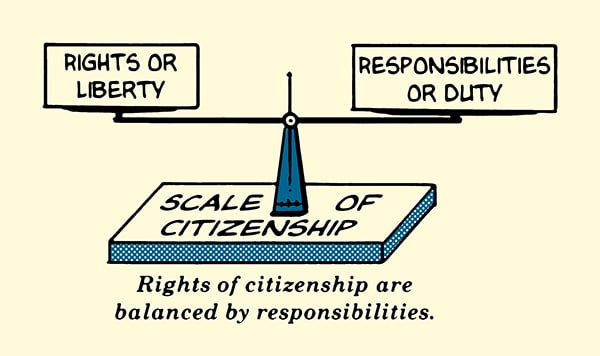
Those of you who have been reading this blog for any length of time know that I take a dim view of those who loudly and irresponsibly trumpet about their rights, but shy away from any discussion of their responsibilities. This is particularly true of those who prioritize the Second Amendment over the lives of children, and the Fifth Amendment above law and civic responsibility.


I am on the waiting list at my local library for a new book by veteran diplomat and policy-maker Richard Haass titled The Bill of Obligations: The Ten Habits of Good Citizens, which appears to say the same thing I've been saying for many years. The book won't be published until later in January, so I don't know yet what his suggested "ten habits" are, but I thought I might dedicate this penultimate post of 2022 to the responsibilities of American citizenship that I think are important, especially at this moment in our history:

1. Recognize that you are part of a larger community, and that other people have rights, too. We Americans have a history of prioritizing the rights of the individual over those of the larger community. Insistence on unrestricted personal rights at the expense of the rights and safety of the community can lead to ... well ... what we see every time there's a mass murder by gunfire or some despicable hate crime.

2. Accept that "freedom" does not mean the ability to do whatever you want, whenever you want, without consequences. I wrote about this back in October in my post titled "The Cognitive Dissonance of Freedom." When you believe that your perceived "freedom" grants you the "license" to break the law or deny freedoms to others, you are a real problem that you're inflicting on the rest of us.

3. Understand that not everyone shares your political opinions. Politics at its best is supposed to be the art of debate and compromise for the common good. It's hard to compromise between people who believe their political opponents are the second coming of Adolf Hitler and those who believe their opponents are whiny, baby-eating libtards. There's a rational political middle out there somewhere that people of good need to rediscover.

4. Understand that belonging to a particular political party does not make you automatically a good or a bad person, but that how you exercise and apply your political beliefs does. Not every Republican is a mindless proto-fascist and not every Democrat is a wild-eyed tax-and-spend liberal. Those that are ... and those who ignore or enable them ... make things a lot harder for those trying to be reasonable and rational within their respective political belief systems. 

5. Accept that there are religious beliefs other than your own, and that their practitioners hold them as deeply as you profess to hold yours. Contrary to what many on the religious right seem to think, the Founders did not intend their new nation to be a theocracy ruled by rigidly intolerant Christians. The First Amendment says "Congress shall make no law respecting an establishment of religion, or prohibiting the free exercise thereof" ... it does not say that the United States is an exclusively Christian nation, or that you are free to impose your beliefs - whatever they are - on others. When your religion tells you to do one thing or act in a particular way, and your neighbor's tells him the opposite, who is right? Who decides? And whose rights are violated if one is prioritized over the other?

6. Recognize also that there are people who have no religious beliefs, and yet manage to be decent people and responsible citizens. Although I was raised in a traditionally religious home, it's been a long time since I've felt any attraction to any organized, ritualized religion ... and yet I try to be a good and caring human, and think those who know me well would probably consider me such ... most of the time, anyhow. 

7. Vote, and accept the outcome even when your preferred candidate loses. The whole ridiculous and dangerous idea that an election you lose is by definition corrupt or stolen undermines the very foundations of representative democracy. If you lose, blame your ideas for being less attractive than those of the other candidate and figure out what you need to adjust in your platform ... don't blame the other side for cheating. It just makes you look like a whiny, spoiled child.

8. Accept that the law applies equally to everyone, rich and poor. This is the American ideal, expressed in the majestic words "Equal Justice Under Law" chiseled over the entrance to the Supreme Court. Of course, as with so many other things in our country, the reality is quite different. If you're rich and can afford world-class lawyers and accountants (and, when needed, raw muscle) to get you off the hook, or buy off elected officials to craft laws in your favor, you come to believe that laws apply to little people, not to you. Just ask Der Furor.

So ...

Mr Haass has ten obligations of good citizenship. I have eight thoughts on the differences between rights and responsibilities. I think we'd be better off as a nation if the Founders had discussed the responsibilities of citizens and not just their rights, but here we are. We need to decide what it means to be a good citizen and what responsibilities come with the rights we enjoy.

Good luck with that.

Have a good day, and be sure to come back on Friday, when we present the final Ass Clown award for the year - the On-Crack Ass Clown for December. More thoughts then.

Bilbo

P.S.  For those of you keeping track, the Ass Clown of the Year standings show the top three vote-getters going into the home stretch as:

Greg Abbott in first place with 1000 votes;

Elon Musk in second place with 531 votes; and,

Kevin McCarthy in third place with 425 votes.

Others with votes piling up, but not yet in the top three, include Mark Meadows, Jim Jordan, Donald Trump, Jr., and Marjorie Taylor Greene. Newly-elected New York GOP Representative George "Everybody Embellishes Their Resume" Santos entered the contest yesterday, netting a meager ten votes.

Don't forget to cast your votes before 11:59 PM on Saturday. Rules and a list of the awardees so far can be found here. Let your voice be heard - vote now! And again later. 

B.


Thursday, April 25, 2019

The Importance of Taking Notes


Many years ago, when I was serving on the Air Staff in the Pentagon, I worked for then-Major General Ken Minihan, who at the time was the Air Force's Assistant Chief of Staff, Intelligence. General Minihan was a great boss and a gifted leader, and we all enjoyed serving under him. But like all of us, he had his faults ... one of which was a very soft voice and a tendency to mumble, which sometimes made it difficult for us to follow what he was saying in meetings. This was coupled with a tendency to host lengthy brainstorming sessions with his staff to hash out difficult problems. He'd begin most meetings by telling us "now, don't write this down" as he went on to think through the issue of the moment out loud.

Naturally, because we were good staff officers, we did write everything down, and we used our notes later to reconstruct the discussions and document the results. This allowed us to create the staff packages that the General could use to make good decisions and implement sound policies. Taking good notes was a critical part of our jobs.

I've told you that story because I think that one of the most interesting things to come out of the Mueller Report on Russian interference in the 2016 elections and on the potential obstruction of justice by Donald Trump and his enablers is this: Trump doesn't like people who work for him to take notes.

General Minihan didn't want us to take notes because he didn't want us to waste our time writing when we could have been thinking and contributing to the discussion. Donald Trump doesn't want his staff to take notes because he hates leaving a paper trail that might come back to haunt him.

Donald Trump doesn't write much, unless you consider thousands of spiteful, insulting, and juvenile tweets to be presidential writing. Past presidents and their staffs left hundreds of thousands of pages of diaries, contemporaneous notes, and commentaries, and presidential libraries are treasure troves of information for historians. New discoveries and insights continue to be uncovered in the papers of George Washington, FDR, and other great presidents. One wonders what sort of presidential library will document the Trump administration. I suspect it will be very small, have few records larger than a tweet, and will not give future generations much insight into the workings of one of the most divisive and poorly-performing presidential administrations in our history.

Documenting what you do, particularly at the highest levels of government, is essential. Many presidential actions have results that will not become apparent for many years ... if nothing else, good documentation lets future administrations understand how and why decisions were made, and how plans and policies evolved in response to changing conditions. The presidential paper trail tells future administrations as much what wasn't done as what was.

It will take the United States decades to overcome the damage done by Donald Trump and his secretive, authoritarian ways. A hundred years or more from now, historians will look back and try to figure out why the nation elected such a man, why he did the things he did, and why so many members of his party ignored his blatant unsuitability for office and blindly supported him. It'll be tougher without the type of written record left by every previous administration.

Have a good day. Write more ... it may be the only way you'll be remembered*.

More thoughts tomorrow, when we name the Left-Cheek Ass Clown for the month. See you then.

Bilbo

* For my earlier rumination on how we'll be remembered, you can look at this post from November of 2009.

Thursday, March 14, 2019

Impeach? Not So Fast ...


Let me say at the outset that I believe Donald Trump is a complete disaster as a president. He has demeaned the dignity of the office, trashed our valuable alliances, cozied up to dictators, and given voice and cover to the worst elements of our society. On a scale of one to ten, with one being Millard Fillmore and ten being George Washington, Trump merits - on his best day - a minus five.

So, what do we do about him?

The first thing to remember is that he has very strong support among a significant part of the population, mostly in the "flyover country" of Middle America that feels its interests have been ignored by traditional political parties and politicians. There is some truth to that.

The main method we have in this country for getting rid of politicians we don't like is the simplest - voting them out of office. Unfortunately, we've gotten to a point where it's more important to some people to protect their party or their incumbent than it is to recognize their faults and vote them out. Republicans despise Democrats and vice versa. Fiendishly gerrymandered Congressional districts protect party politicians long after they've failed to deserve protection and re-election.

The other method we have of getting rid of politicians - specifically, presidents - is impeachment, which is enshrined in Article II, Section 4 of the Constitution:

"The President, Vice President and all civil Officers of the United States, shall be removed from Office on Impeachment for, and Conviction of, Treason, Bribery, or other high Crimes and Misdemeanors."

There are two important things to remember about impeachment:

1) Impeachment takes place in the House of Representatives. Conviction takes place in the Senate. If you insist that Trump be impeached, consider that it can be made to happen in the Democratic-controlled House, but that he will never be convicted in a firmly Republican-controlled Senate. Unless there is unshakeable bipartisan agreement on specific, proven-beyond-any-reasonable-doubt-or-objection-and-so-blindingly-obvious-that-even-the-worst-die-hard-partisan-can't-deny-them impeachable crimes*, the time and effort put into impeachment is wasted, and could have been better spent on other important issues.

2) The Constitution does not clearly define the terms treason, bribery, and high crimes and misdemeanors. Axis Sally and Lord Haw-Haw were clearly guilty of treason as it is traditionally understood; but does Trump's cozy relationship to figures like Vladimir Putin and Kim Jong-un equate to treason? It depends on your politics and your degree of sanity. I think it's naive and dangerous, but I don't think it's treason. What's the difference between huge, anonymous campaign contributions from a Super Pac, a corporation, or a friendly billionaire and bribery? Again, it depends on your political point of view: defenders call campaign contributions (of any size) Constitutionally-protected free speech; opponents call it bribery**. And what is a high crime or misdemeanor? Murder, probably. Abuse of presidential power? It depends on your politics - what to one party is forceful and determined leadership can appear to be reckless abuse of power by the other.

Where am I going with all this?

I tend to agree with Speaker of the House Nancy Pelosi on the impeachment issue. In a recent press conference, Ms Pelosi said that

“. . . Impeachment is so divisive to the country that unless there’s something so compelling and overwhelming and bipartisan, I don’t think we should go down that path, because it divides the country. And he’s just not worth it.”

That's not what most people who despise Donald Trump as much as I do want to hear, but it's the right answer - Constitutionally, procedurally, legally, and morally. The right way to get rid of Trump is not to waste time and effort on an impeachment fight that will go nowhere, but to come up with a legislative program that makes more sense than his, and addresses the problems of many Middle Americans in a rational, Constitutional, and economically sensible way. And, in 2020, to vote him out and let the courts decide*** any civil issues arising from his behavior in (and outside of) office.

People who think Trump doesn't just walk on water, but changes it into wine and then walks on it, will never change their minds. An impeachment fight will just let them blindly justify their support for a man who doesn't deserve it by allowing them to picture him as a heroic figure beset by evil and relentless enemies who don't recognize his greatness.

He's just not worth it.

Have a good day. See you back here tomorrow, when we name the Left-Cheek Ass Clown for March.

Bilbo

* And legal experts aren't quite sure what those might be, believe it or not.

** I call it "bribery," too, but I'm no lawyer. Thank goodness.

*** I find the legal idea that "you can't indict a sitting president" to be pretty stupid, as it implies that the president is above the law. Again, it's a good thing I'm not a lawyer ... I'd probably die of terminal cognitive dissonance.

Tuesday, March 12, 2019

Yes, You Can. But Should You?


One of my Mother's favorite maxims was: "Just because you can do something doesn't mean you should do it."

I think about that a lot lately, usually when the news announces that Donald Trump has done some questionable thing because the president has the authority to (fill in the action du jour). Want to override the advice of intelligence and security professionals and demand that your children get top secret security clearances? The president has the authority to grant security clearances*. Want to launch missiles at (insert country here)? According to the War Powers Resolution, the president has the authority to commit forces without a Constitutionally-mandated Congressional declaration of war**. Want to build a wall that Congress won't support? The president has the authority to bypass Congress by declaring a national emergency***.

It doesn't just apply to Mr Trump, either. Upset at election reform legislation passed by the House of Representatives? Senate Majority Leader Mitch McConnell was able to prevent it from having Senate action because I get to decide what we vote on. Angry because you can't get Congress to do anything? President Obama had a phone and a pen.

Just because you can do something doesn't mean you should do it, as Mom would have said. Or, in the words of Dan Carlin, imagine that power in the hands of someone you hate.

Food for thought, for those of us still thinking nowadays.

Have a good day. More thoughts coming.

Bilbo

* 50 USC §3341 specifies the process for granting security clearances, but as far as I can see it only gives the president the authority to designate agencies to grant clearances. It does not grant the president the power to grant clearances on his own, although this may be considered a derivative of his other powers ... I'm not enough of a legal eagle to decide.

** Article 1, Section 8 of the Constitution gives Congress the power to raise and support an army and to declare war. The last time there was a formal declaration of war was in 1942, when Congress declared war on the Axis allies of Germany, Italy, and Japan.

*** 50USC §1631:  "Declaration of national emergency by Executive order; authority; publication in Federal Register; transmittal to Congress. When the President declares a national emergency, no powers or authorities made available by statute for use in the event of an emergency shall be exercised unless and until the President specifies the provisions of law under which he proposes that he, or other officers will act. Such specification may be made either in the declaration of a national emergency, or by one or more contemporaneous or subsequent Executive orders published in the Federal Register and transmitted to the Congress."


Wednesday, March 07, 2018

The Decline of Courtesy Titles


As a general rule, we Americans don't like titles. The Constitution even clearly states (Article 1, Section 9) that "No Title of Nobility shall be granted by the United States." 

We have no Dukes or Earls*, Counts or Viscounts, Barons or Baronets, Lords or Ladies. Of course, we do have an aristocracy here in the US of A, we just pretend it isn't there, and we don't mark it with formal titles of nobility. The American aristocracy is based on wealth and the perception, if not the reality of success, rather than on family lineage **.

Most of us who aren't in the military, a fraternal organization, or some stratified business don't have titles. We're not "colonels," "generals," or "admirals;" "Illustrious Potentates***" or "Grand Poobahs;" or "Presidents" or "CEOs." We're just ... well ... average Joes or Janes.

Which brings me to this 2017 article from Intellectual Takeout: "Why We Should Bring Back 'Ma’am' and 'Sir'." The article laments the loss of the courtesy and gentility we used to convey by using courtesy titles like sir and ma'am. Here's the money quote:

"Unfortunately, the day is coming when no one will make the mistake of calling [someone] either 'sir' or 'ma’am' because the generation now coming of age believes a clipped 'No' or 'Yes' is all that is required of them, no matter the title, education or age of the person to whom they are speaking."

Some people object to the use of sir and ma'am (or miss) because they're viewed as archaic and sexist, and perhaps they are - sexist, I mean, rather than archaic. After all, in today's cultural environment, it's not considered polite or proper to draw a distinction in address between a married ("ma'am," in verbal address and "Mrs" in writing) and a single ("miss") woman. I must admit, though, that I use both terms when addressing women, but use them as a matter of courtesy based on age and maturity rather than on marital status†. And not many people outside of the military (and my family) say "sir" or "ma'am" any more when addressing an adult whose name they do not know††.

I believe that something is lost when we don't address people courteously. The late comedian Rodney Dangerfield used to moan, "I don't get no respect," and it's true that many of us today don't show respect to one another. Indeed, the showing of respect based on age, education, or significant achievement ... or anything else ... is often viewed as being subservient to another person. We demand respect from others, but are unwilling to give it ourselves.

How should we address people we don't know? There's no single answer on which all agree, but this summary from an interesting article on dictionary.com sounds good to me:

"What is the proper manner to address men and women††† today though? Well, it isn’t impolite to ask how someone wants to be addressed. Respect can come in the way you address someone as well as in the thought that goes into that address."

Have a good day. Be courteous and respectful. More thoughts tomorrow.

Bilbo

* The Duke of Earl doesn't count.

** Although we have lots of "aristocratic" families in various realms: in politics, the Kennedys and Bushes; in entertainment, the Fondas and the Kardashians; in business and industry the Rockefellers, Carnegies, and ... yes ... Trumps.


*** I can see myself as an "Illustrious Potentate" ... see my post on that topic here.

† I don't think "Ms" translates well from the printed page to the realm of the spoken word ... "miz" grates on the ear in a way "ma'am" or "miss" doesn't. But that's just me.

†† "Master" was once used as the form of address for a young man, but nobody says that any more.

††† It gets even more complicated ... some people are pushing "Mx" as a gender-neutral abbreviation. And I have no idea how to pronounce it ... "mix" sounds stupid to my traditional ear.

Thursday, November 09, 2017

Oh, Poo, Revisited


India is one definitely one of the most bizarre nations on earth. On the one hand, it has a space program and a booming high-technology sector*. On the other hand, its government is working hard to get Indians to stop pooping outdoors.

You may recall that three years ago, I wrote a post about a major Indian government program called "Poo2Loo" that uses clever songs and animated cartoons with dancing poop to try to convince Indians, who are seriously short of public toilets (and of indoor plumbing in many areas) to stop relieving themselves at will in public places. The Poo2Loo campaign invested millions of dollars** to convince Indians that they really ought to do their business in appropriately private locations.

Which brings me to this article from last Sunday's Washington Post: India Turns to Public Shaming to Get People to Use Its 52 Million New Toilets. Yes, Dear Readers, the Poo2Loo campaign having not quite squeezed out*** its goal of getting Indians to quit defecating in public, "teams of government employees and volunteer 'motivators' roam villages to publicly shame those who relieve themselves in the open," such as this poor fellow, whose post-relief wash-up bucket was seized and broken by a local poop patrol, and who was presented with a rose as a peace offering ...


In some areas, according to the article, "... people without toilets risk having their welfare benefits taken away and can be barred from running for public office."

Hmm ... if people who are full of crap can be barred from running for office, perhaps India - without knowing it - is on to something. I wish I'd thought about this a year ago.

Have a good day. Poop in designated places to avoid embarrassment.

More thoughts tomorrow, when we unveil the latest collection of Great Moments in Editing and Signage. See you then.

Bilbo

* Your favorite help desk and telephone service center is probably in India, as are many of the online scammers looking to separate you from your money and your data.

** According to the article, the US Agency for International Development has also pledged $2 million annually and introduced ranking systems to trigger “(sanitation) competition between cities," and the World Bank has also offered a $1.5 billion loan to help encourage public sanitation efforts.

*** Sorry.

Wednesday, October 04, 2017

How "Theologically Dense" Is It to "Love Thy Neighbor?"


Those of you, Dear Readers, who have been following my ruminations over the life of this blog, know that I have a fairly conflicted relationship with religion. I was baptized as a Byzantine Rite Catholic, raised in a Roman Catholic tradition, and now self-identify as a Seventh-Day Absenteeist.

Although I no longer adhere to any particular religious tradition, I follow the influence of religious belief on our lives and our politics with great interest, which is why this headline from CNN leaped out at me last week: Conservatives Accuse the Pope of Spreading Heresy. According to the report, more than 60 conservative Catholic scholars and clergy sent a 25-page letter to Pope Francis, accusing him of spreading seven specific heretical beliefs.

The letter is described in the article as being "theologically dense." This means, if you aren't steeped in the minutiae of complex theological argument, you can't follow it.

And this is my problem with most religions as they exist today. Numerous things, actions, and beliefs are "un-Islamic." Various actions and beliefs are "un-Christian." Arguments are "theologically dense." If you don't worship my way, you're a heretic, an apostate, or whatever.

How did we get here? Consider the words of Jesus in chapter 22 of Matthew, verses 35 through 39 ...

35 Then one of them, which was a lawyer*, asked him a question, tempting him, and saying,
36 Master, which is the great commandment in the law?
37 Jesus said unto him, Thou shalt love the Lord thy God with all thy heart, and with all thy soul, and with all thy mind.
38 This is the first and great commandment.
39 And the second is like unto it, Thou shalt love thy neighbor as thyself.

How did we get from two laws - (1) Love God, and (2) Love your neighbor** - to a 25-page, theologically dense letter accusing Pope Francis of heresy for ... well ... daring to suggest we should love our less-than-perfect neighbors?

Those two great commandments expanded into the Ten Commandments, which eventually begat the Code of Canon Law of the Catholic Church, which is divided into seven books, containing 1,752 individual "canons." Consider also that Islam is wrapped around the theological axle of the Koran, the Hadith, and the millions of interpretations of them that Islamic scholars have generated over the years. And finally, consider that when we describe an argument as Talmudic, it implies that it is "characterized by or making extremely fine distinctions; overly detailed or subtle; hairsplitting."

Love your neighbor. Only three words.

Is that so hard?

Have a good day. More thoughts tomorrow.

Bilbo

* Well, he would be, wouldn't he?

** If you read the seven heretical beliefs with which Pope Francis is being charged, he is essentially charged with upholding the commandment to love one's neighbor. What kind of irreligious bum would do that?

Monday, August 21, 2017

Jury Duty ... Again


You may remember last month, Dear Readers, that I was summoned for jury duty at the local Circuit Court. In Fairfax County, the way it works is that you are summoned to appear for one day. If selected for a jury, you serve until the end of the trial; if not selected, you are taken off the list of prospective jurors and are not eligible to be called up for three years.

Well ...

The same week I received the summons from the county court, I also received one from the US District Court for the Eastern District of Virginia ... a judicial double-header, as it were. The US District Court summons is a lot different from the local one: first of all, I'm on call for two weeks, rather than just one day; I had to call in after 6:00 PM last Friday to see if I was scheduled to appear today, and I have to call after 6:00 PM every day of the on-call period to see if I am scheduled to report on the following day. Today is the first day of my two weeks, and I don't have to report, but I'm still on the hook until September 1st.

I don't mind being summoned for jury duty, which is a small price to pay to live in the wonderful country I do. But I do wonder why the systems are so different.

For instance, on the day I was called up for Fairfax County, I reported to the jury assembly room at the courthouse, where my summons was scanned in by cheerful court officers. I was allowed to bring my phone and my iPad, and the room provided free Wi-Fi for the prospective jurors while we waited. At the US District Court, however, we are not permitted to bring phones or tablets or anything with a recording capability, which will make things difficult for those who haven't mastered (or who have forgotten) the art of reading actual ink-on-paper books and magazines. And, of course, being on call for two weeks makes it impossible to plan for any travel or daytime events during that period. AAARRRGGGHHH!!!

Well, I guess we'll see what happens. I'll keep you posted. If I miss one or more days of posts over the next two weeks, you'll know what happened.

In the meantime, if you are near the path of today's total eclipse of the sun, please be careful when you watch it ... your eyes will thank you.

Have a good day. More thoughts tomorrow.

Bilbo

Monday, July 31, 2017

Jury Duty


Yes, Dear Readers, yours truly has been summoned to report for jury duty at the Fairfax County Circuit Court today. I need to report to the courthouse early, so this will be a relatively short post.

Being summoned doesn't mean that I will actually end up on a jury ... just that I have to show up and be available for interview and possible selection to sit on a jury. If it goes like the last few times I was called up, I'll sit in the assembly room all day until a bailiff comes in, thanks those of us who haven't been selected, and tells us we can go home and be free for another three years, at which time we'll be eligible to be called up again.

Ah, well ... like paying taxes, it's one of the obligations of citizenship. And who knows? This time, I may even get selected! I'll let you know how it turns out.


Have a good day. More thoughts tomorrow.

Bilbo

Wednesday, July 19, 2017

It May Be "Legal," but Is It Right?


This is a question posed by Asha Rangappa, an associate dean at the Yale Law School and a former FBI agent, in a recent op-ed article in the Washington Post. In order to answer that question, Ms Rangappa turned to an individual with whom FBI agents are familiar.

Carla F. Bad isn't a real lady, but a mnemonic device to help FBI agents remember the elements they use to assess the suitability of persons for positions of public trust: Character, Associates, Reputation, Loyalty, Ability, Finances, Bias, Alcohol, and Drugs.

As Ms Rangappa writes about the technical question of whether or not Donald Trump and his associates have broken the law,

"... focusing on bright-line rules of criminality misses the point. The deeper question is whether members of Trump’s administration can uphold the trust that has been placed in them as stewards of the government they have been chosen to lead. On this front, the criminal code shouldn’t be the only yardstick. Even if Trump’s aides and family members have managed to toe the line of the law, the news out of the Russia investigation so far leaves little reason to have faith in their judgment."

Let's see how Ms Bad would assess Donald Trump ...

Character: The man is a congenital and unrepentant liar who doubles down on his untruths in the face of evidence to the contrary. His ability to evade censure for the most blatant lies is amazing.

Associates: Vladimir Putin. 'Nuf said.

Reputation: Golden with about 39% of the electorate; in the toilet with the other 61%. And he's not particularly well thought of in financial circles, either.

Loyalty: Demands it of subordinates, but isn't known for returning it.

Ability: During the presidential campaign, he memorably said that the United States was in terrible shape and "I alone can fix it." So far, I haven't seen anything fixed, Congress is a laughable circus bereft of presidential leadership and direction, and the international leadership of the United States has vanished.

Finances: Mr Trump has filed for bankruptcy six times, although in fairness, most involved his casino properties and happened during a period when the casino industry overall was struggling. He has been sued at least 60 times by individuals and businesses seeking payment for services provided to Trump and his properties, and has bragged that not paying taxes means he's "smart." Don't hold your breath waiting for his tax returns.

Bias: Mr Trump does not care for Mexicans or for men who have been prisoners of war*. He also does not want to have any "poor" people in positions of economic responsibility in his administration. In general, he is biased against "losers."

Alcohol: No problems - Mr Trump is reported to be a teetotaler.

Drugs: No reported problems. Although there have been unproven rumors of past drug use, the only drug Mr Trump is reported to be taking is finasteride, which is used to combat male-pattern baldness.

So, how do Mr Trump and Ms Bad get along?

Giving points for a lack of problems with alcohol or drugs, Mr Trump scores only Carla's first name and middle and last initials ... but given the evidence for them, it's bad enough.

Mr Trump may skate at the very edge of what's legal, but if he were a young person trying to get a security clearance, Ms Bad would probably argue against him on seven out of nine grounds.

And we've elected him president. What does that say about us?

Have a good day. More thoughts tomorrow.

Bilbo


* Although he never ran the risk of becoming one, never having served in the armed forces.

Monday, May 08, 2017

Pre-Existing Conditions


One of the most contentious elements of the ongoing fecal maelstrom over health care is the responsibility (or not) of insurance companies to cover the treatment of pre-existing conditions. How that term is defined, and what sorts of conditions are considered "pre-existing," are at the heart of the debate.

Here is a good basic definition of pre-existing condition, taken from Investopedia: "Any personal illness or health condition that was known and existed prior to the writing and signing of an insurance contract."

Insurance companies write, price, and issue policies depending on their assessment of the relative risk to their bottom line - that is, the likelihood that they will have to pay out benefits to policyholders. It's obvious that, from a purely business perspective, an insurance company doesn't want to issue a policy to an individual if they already know that individual represents a bad risk - will cost the company far more in benefits than the individual has paid in premiums. The assessment of risk is why auto insurance companies charge more to insure a teenage male driver than a middle-aged female, or cancel the policies of persons whose record shows multiple accidents for which they are at fault. It's why property insurers charge more to protect homes built on top of earthquake fault lines or in areas prone to wildfires.

Health insurance is a bit different, though. Obviously, it's cheaper and a much better risk to insure a person who is young and fit and less likely to need medical care than to insure an older person who, in the natural scheme of things, is probably more prone to conditions which will require increasingly expensive treatment. The paradox is that young, fit people who think they'll live forever don't want to waste* money on insurance ... but later on, when they're older and really need it, they'll have accumulated a raft of pre-existing conditions that may price the necessary coverage out of their reach.

What are some of the pre-existing conditions that are sometimes cited by insurance companies as justification for higher rates, or for the denial of coverage altogether? Here are some of the commonly-cited conditions which have resulted in automatic denial of coverage**:

AIDS/HIV;
Alcohol or drug abuse with recent treatment;
Alzheimer’s/dementia;
Anorexia;
Arthritis;
Bulimia;
Cancer;
Cerebral palsy;
Congestive heart failure;
Coronary artery/heart disease, bypass surgery;
Crohn’s disease;
Diabetes;
Epilepsy;
Hemophilia;
Hepatitis;
Kidney disease, renal failure;
Lupus;
Mental disorders (including Anxiety, Bipolar Disorder, Depression, Obsessive Compulsive Disorder, Schizophrenia);
Multiple sclerosis;
Muscular dystrophy;
Obesity;
Organ transplant;
Paraplegia;
Paralysis;
Parkinson’s disease;
Pending surgery or hospitalization;
Pneumocystic pneumonia;
Pregnancy or expectant parent (includes men);
Sleep apnea;
Stroke; and,
Transsexualism.

That's quite a list, and I'm pretty sure that it covers a significant portion of the population. I'm just glad that my arthritis and sleep apnea were diagnosed well after I'd already obtained my insurance, or I'd be up the creek without a medical paddle.

There are a few other conditions I'm surprised aren't on the list. They include:

Life (after all, if you weren't alive, you wouldn't need to worry about health care);

Poverty (which will, in many cases, prevent you from obtaining the routine care that will prevent the development of other pre-existing conditions); and,

Stupidity (which prevents you from recognizing that you are being screwed by the health care insurance system, and allows you to vote for elected officials who do not have your best interests at heart).

Oh, and it should be noted that while mental disorders are considered a pre-existing condition which will preclude the purchase of health insurance, they are not considered serious enough to preclude the purchase of firearms*** (see Stupidity, above).

If you suffer from anything on this list, or any other list maintained by any of the 50 states or any insurance provider, good luck. You're on your own.


Have a good day. More thoughts tomorrow.

Bilbo

* From their perspective.

** From a December 2016 report on the topic from the Kaiser Family Foundation. You can see the list in context and read the full report here.

*** Not completely accurate, but close.


Monday, February 13, 2017

Why Are We Still Arguing About Immigration Policy?


I can't believe we are still arguing about immigration enforcement and reform after all these years. No, wait ... yes, I can ... because every discussion ends up with people on all sides shouting past each other, and immigrants - both legal and illegal - caught in the middle. The election of Donald Trump and the legitimization (by his ignorant rhetoric) of anti-immigrant feelings has led to a fresh round of anti-immigrant sentiment and a new tidal wave of raids designed to arrest and deport illegal immigrants.

I am, as are all Americans (including those we call Native Americans), the descendent of immigrants*. My paternal ancestors came to the US (legally) from Hungary, and my maternal line goes back to ancestors who immigrated (legally) from Germany. I am married to a fully-legal, green-card holding German who has worked and paid taxes in the United States since 1983. I have no problem whatsoever with legal immigration, because our country was built on it. I do, however, have a problem with those who - for whatever reason - choose to ignore the law and come here illegally. While their intentions may be good, their willingness to ignore the law is not.

I know from experience that navigating the legal immigration system is a pain in the neck. When I married my wife, it took months to maneuver through the system, with numerous trips to the American consulate for round after round of interviews and various hospitals for various tests. I had to arrange for the translation of hundreds of pages of documents written in convoluted legal German**, and at one point I commented - only half-jokingly - that the rule seemed to be that when the weight of the paperwork exceeded the weight of the bride, we'd get the visa. This is why I have no sympathy for those who choose to ignore the established process and enter the country illegally.

But while I have no sympathy for those who ignore the law, I have even greater disdain for those who rant and thunder about the horrors of illegal immigration, but offer no suggestions for solving the problem beyond such stupid placebos as "build a wall" or "deport them all." Those of you who have been long-time readers of this blog know that I have already floated (several times, with incremental adjustments) my recommended plan for immigration reform. I won't repeat it again ... if you're new to this blog, you can go back and read the most current version of my plan here. I'll be the first to admit that there may be some weak spots or difficult legal issues to overcome, but I think it's one of the first - and perhaps the only - serious, comprehensive, and realistic plans to fix our broken immigration system.

Many complain that illegal immigrants come here to steal jobs from decent, hard-working, taxpaying American citizens. This is patently stupid. Large numbers of immigrants do, in fact, come to America in search of work, but the jobs they take are largely those that Americans don't want to do for the wages and conditions offered. I haven't seen long lines of jobless Americans signing up to pick crops in the hot sun, or to do the miserable and bloody scut work needed by our industrial meat industry. Nor are they lining up to be maids, janitors, dishwashers, busboys, taxi drivers, trash collectors, and landscape workers. If they were, there wouldn't be a market for immigrants - legal and illegal - willing to take those jobs.

And consider this: the price you pay for your produce is kept relatively low because the people who pick it - largely illegal immigrants - are paid extremely low wages. Deport all those migrant farm workers, replace them with American citizens (if you can find any willing to work that hard), and watch your grocery prices skyrocket as they receive the pay and benefits legal American workers demand. If you're willing to pay more for your food in order to get rid of the people who keep your prices down, good for you.

At the upper end of the immigrant spectrum, the law allows firms who need the skills they aren't finding in American workers to sponsor visas for appropriately-skilled immigrants. Perhaps if we encouraged more Americans to become scientists, engineers, and doctors, there would be less demand for qualified immigrants. Hmmm ...

Bottom line: let's enforce our immigration laws, but smartly. Let's get serious about understanding the scope of the problem and coming up with real, workable solutions that are both legal and representative of our character as a nation that welcomes legal immigrants and the skills and cultural gifts they bring.

Have a good day. More thoughts tomorrow.

Bilbo

* Yes, even the people we call "Native Americans" came here originally from someplace else ... many across the land bridge that used to connect Siberia with Alaska. Of course, you can still see Siberia from Sarah Palin's porch.

** Think American legalese is bad? You have NO idea ...

Sunday, December 25, 2016

Christmas Day, 2016


If you came here looking for Musical Sunday, come back again in two weeks ... today is the day for Bilbo's Traditional Christmas Post.

Today is Christmas Day, the day on which Christians around the world celebrate the birth of Jesus Christ, whose lessons and example many of them find great in theory but decline to follow in practice. Beyond the Christian world, it is a season for general good cheer, the exchange of gifts, and a month of uplifting and sentimental television shows which temporarily replace the sex, violence, and cynicism of the rest of the year.

We’ve long bemoaned the commercialization of Christmas, in which the purchase and exchange of gifts has replaced thoughtful contemplation and love of family. But now, Christmas has been politicized as well. Conservative shouting heads complain about a “war on Christmas,” and both Christians and non-Christians complain about discrimination because they don’t want to have to accommodate religious ideas and traditions which are not their own. Angry idiots object to hearing a generic “Happy Holidays” instead of "Merry Christmas," "Happy Hanukkah," "Happy Solstice," "Happy Kwanzaa," "Happy Festivus," or other seasonal holiday of choice. Nuisance lawsuits force towns and cities to remove nativity displays from public places. Scrooge lives on.


The traditional Christmas story that most of us recognize is told in the Bible in the second chapter of the gospel of Matthew:

2:8 And there were in the same country shepherds abiding in the field, keeping watch over their flock by night. 
2:9 And, lo, the angel of the Lord came upon them, and the glory of the Lord shone round about them: and they were sore afraid. 
2:10 And the angel said unto them, Fear not: for, behold, I bring you good tidings of great joy, which shall be to all people.
2:11 For unto you is born this day in the city of David a Savior, which is Christ the Lord. 
2:12 And this shall be a sign unto you; You shall find the Babe wrapped in swaddling clothes, lying in a manger. 
2:13 And suddenly there was with the angel a multitude of the heavenly host praising God, and saying, 
2:14 Glory to God in the highest, and on earth peace, good will toward men.

Whatever happened to the part about “peace on earth and goodwill toward men*?” It seems to have been replaced by “peace on earth, goodwill only to those who agree with me, and the rest of you can go to Hell.” It’s been replaced by rigid intolerance and stiff-necked self-righteousness that belie both the spirit of the season and the values and teachings of the person whose birth is being celebrated.

Nevertheless, for those willing to put aside their cultural tunnel vision and their petty carping and hatreds, the Christmas season offers a time for joy and renewal, regardless of the religious tradition they profess to follow. It’s a season in which men (okay, persons) of goodwill can come together and treat each other like real human beings rather than like despised “others” … if, of course, they’re willing to bend enough to do so.

And it is, above all, a season for children, who have not yet been spoiled by the cynicism and hatred they’ll learn all too soon. The look on a child’s face on Christmas morning is a wonderful thing, and it reminds us that there is still joy to be found in life, if only we can get past the greed, selfishness, and political chicanery.

And so, Dear Readers, Agnes and I and our extended family wish all of you a very joyous Christmas and a safe, happy, and healthy new year. Blog on!

Have a good day. More thoughts tomorrow.

Bilbo

* Okay, “persons.” Don’t get your holiday knickers in a twist.

Tuesday, September 20, 2016

No Pardon


The release of Oliver Stone's new film Snowden has become part of a groundswell of opinion holding that Edward Snowden - the man who stole millions of highly classified documents and released them to the world - should be pardoned and allowed to return to the United States from his refuge in Russia.

I most strongly disagree.

I have many reasons for considering Mr Snowden to be a despicable and hypocritical traitor to his country, and this article by Jack Goldsmith from the Lawfare blog sums them up better than I could: Why President Obama Won't, and Shouldn't, Pardon Snowden. It's a little long, but it's well worth your time to read, especially if you think Mr Snowden deserves to be pardoned for what he did.

One could argue, however weakly, that Mr Snowden performed a public service by exposing a program that could have had questionable legal underpinnings. However, he also exposed many other programs that were fully legal and approved by Congress - programs the loss of which gravely injured the Intelligence Community's ability to track our enemies and keep you and I safe. He would have you believe that he had no other option than to expose programs he believed - in his boundless wisdom - were illegal. In fact, members of the Intelligence Community have a robust and accessible oversight structure in which they can report suspected violations of the law. Anyone who has worked in this arena knows that his contention that he had no other options is ludicrous.

A pardon for Edward Snowden is a slap in the face of all those who toil anonymously in the intelligence world to keep us safe, who take their oaths seriously, and who understand that intelligence programs are kept secret not because they are illegal*, but because they are fragile and their exposure can undo years of work and millions of dollars of expenditure.

And by the way, Mr Snowden has chosen to take refuge in Russia ... and one might well ask whether he would have been pardoned by the government of Mr Putin for the same crimes he committed here at home. If you believe that, I can make you a good deal on a bridge.

No pardon for Edward Snowden. Ever. Let him enjoy his exile in a country that would certainly have imprisoned ... and very likely executed ... him had he done the same thing there.

Have a good day. More thoughts tomorrow.

Bilbo

* There is a widespread belief that anything marked "secret" is classified only because it is illegal, would embarrass the government, or covers up other malfeasance. Nobody seems to want to acknowledge that some things need to be kept secret for very good reasons.

Wednesday, March 16, 2016

Bilbo's Suggestions for Government Reorganization


Yesterday I talked about the hue and cry over the size of government, and the lack of specific proposals for what to actually reduce. Well, except for those put forward by Ted Cruz, with which I disagree for the most part. Here are the first of my own ideas:

Today there are 15 Cabinet Departments:

Agriculture;
Commerce;
Defense;
Education;
Energy;
Health and Human Services;
Homeland Security;
Housing and Urban Development;
Interior;
Justice;
Labor;
State;
Transportation;
Treasury; and,
Veterans’ Affairs

I propose to reduce that number to seven:

State;
Treasury (incorporating parts of Homeland Security);
Justice (incorporating parts of Homeland Security);
Labor and Commerce;
Defense (incorporating parts of Homeland Security);
National Infrastructure (consolidating and incorporating parts of Agriculture, Energy, HUD, Interior, and Transportation); and,
Citizens’ Services (consolidating and incorporating parts of Education, Health, and Veterans’ Affairs)

This does not, of course, address the large number of independent establishments and government corporations, many of which I would either eliminate outright or fold into one of the cabinet departments.

I'm a little short on time this morning, so I don't have enough time to elaborate on these ideas. However, over the next week or two, I'll look at each of my proposed new cabinet offices, explain what I'd eliminate and why, and how the reorganized government might function better.

Have a good day. More thoughts tomorrow.

Bilbo

Tuesday, March 15, 2016

Cut Government Down to Size, Hold the Hyperbole


One of the major tenets of modern conservative and libertarian philosophies is that government at all levels must be kept as small and inobtrusive as possible consistent with what we need it to do. This has led to calls for major cuts in the Federal government, in particular, to eliminate agencies that are unnecessary, too large, overly powerful, or otherwise undesirable from a philosophical or constitutional perspective.

For what it’s worth, I agree that government should be lean and … well … not mean, but agile and responsive, without needless layers of bureaucracy that delay action and diffuse responsibility. I believe, as do many conservatives and libertarians, that government is best when it’s closest to the governed … meaning that our most important levels of government are those at the local (city, county/parish, or state) level, where elected and appointed officials have more direct insight into local concerns.

I don’t think too many people would argue with ideas like those. But what a whole lot of people argue with are the specific cuts to be made and the final shape and responsibilities of the government at each level. It all depends on whose ox is being gored, to use the old expression.

Why has government grown so large? There are a lot of reasons; here are a few:

1. Because we wanted it to. Nobody really wants to hear that, but it's true. Because we, as a nation, have decided we want water we can drink, air we can breathe, medicines that are safe, and many other things, Congress has created cabinet departments and various agencies to see that these things are accomplished.

2. Because Congress almost never builds a "sunset clause" into legislation that establishes new agencies. Perhaps the original purpose of a particular office or agency was achieved, but bureaucracy has its own inertia, and if there's no direct order to close or life span established for it, it will go on forever.

3. Because a large government provides employment for a lot of civil servants (or bureaucrats, to use the pejorative term), and because it provides a very large number of political patronage positions* that can be used to reward the incumbent party faithful, there's not much incentive for Congress or the Executive Branch to cut back.

4. Because nobody outside of their organization knows what most government agencies do. I can pretty much guarantee you that the Cabinet officers don't have a real idea about what most of the people in their organizations are actually doing ... and if they don't, why should anyone else? 

There are probably other reasons, too, but those four will do for a start. 

So, it's easy to shout that government is too big and must be pared back to make it less expensive and more responsive, and that's not a bad thing. But what - specifically - should be eliminated?

Almost no one who runs for office is willing to be specific on this issue, because every government organization, no matter how small, has a constituency that a politician is loath to offend. The major exception in the current presidential campaign is Senator Ted Cruz, whose website lists five agencies he would eliminate, calling them by the catchy term "Five for Freedom."  They are (with the language of his website in parentheses):

The Internal Revenue Service ("end the political targeting, simplify the tax code, and abolish the IRS as we know it");

The Department of Education ("return education to those who know our students best: parents, teachers, local communities, and states. And block-grant education funding to the states");

The Department of Energy ("cut off the Washington Cartel, stop picking winners and losers, and unleash the energy renaissance");

The Department of Commerce ("close the “congressional cookie jar” and promote free-enterprise and free trade for every business"); and,

The Department of Housing and Urban Development ("offer real solutions to lift people out of hardship, rather than trapping families in a cycle of poverty, and empower Americans by promoting the dignity of work and reforming programs such as Section 8 housing").

As you might suspect, I have a few comments on his choices:

The IRS is everyone's favorite whipping boy, and abolishing it certainly has wide appeal. I hate the IRS as much as anyone. Unfortunately, the 16th Amendment to the Constitution**, ratified in 1913, granted Congress the power to levy an income tax, and Congress in turn established an agency (the Bureau of Internal Revenue, the forerunner of today's IRS) to administer the taxation program. The IRS will remain a hated and feared, yet necessary institution until other structural problems with government organization and spending allow it to be reduced (but likely never eliminated). And remember: you may hate the IRS, but it exists only to administer the tax laws which are written by ... yes, Congress.

Eliminating the Department of Education is, in my humble opinion, a staggeringly bad idea. It sounds great to "return education to those who know our students best: parents, teachers, local communities, and states," but when people (mostly conservatives) belittle teachers and state and local agencies slash education funding to pay for other things, I have little confidence in the interest or ability of state and local government agencies at those levels to educate our children***. And considering that religious conservatives ceaselessly and unconstitutionally work to impose religiously-based curricula in our schools, I think someone needs to be the watchdog. Should there be some local control over schools: yes. Should the federal government run all our schools: certainly not, but it has a legitimate role in establishing minimum national standards for education ... because a democracy relies on an educated and informed population.

I think there's a good argument to be made for cutting back on the size and power*** of the Department of Energy ... most of its functions could probably be folded into other existing agencies. But I'm not sure I understand how eliminating the DoE would "unleash the energy renaissance." Sounds like wild hyperbole to me.

Eliminating the Department of Commerce is an interesting choice for a self-described strict follower of the Constitution, because the Constitution specifically assigns the Congress the responsibility "to regulate Commerce with foreign Nations, and among the several States, and with the Indian Tribes" (Article 1, Section 8, Clause 3). Should the Commerce Department's duties be changed or limited, or folded into another agency? Perhaps. But eliminating it outright ... bad move, and arguably unconstitutional.

Getting rid of the Department of Housing and Urban Development is something I could probably support, although only after a careful review to identify programs that ought to be retained and reassigned to other agencies. This is a prime example of an agency that ought to be working at the state and local, rather than the national level, with governors and mayors working those issues for their states and cities.

So much for my opinion of what Mr Cruz wants to do. I think he's a few eggs short of an omelette, but at least he's put a plan forward. What would Bilbo eliminate from the government? We'll address that in the coming days.

Have a good day. Don't scream and shout ... study and plan and offer rational, defensible suggestions. If you can't do that, please sit down, shut up, and let the adults figure things out.

More thoughts coming.

Bilbo

* Every four years the Government Printing Office publishes a book titled United States Government Policy and Supporting Positions, commonly known as "The Plum Book." The current (2012) version is 220 pages long and lists every position available for the incoming administration to fill, along with details of the present incumbent, pay grade, tenure, expiration date (if any), etc. It makes for some fascinating reading.

** "The Congress shall have power to lay and collect taxes on incomes, from whatever source derived, without apportionment among the several States, and without regard to any census or enumeration."

*** Mary Lou Bruner, 68, a former kindergarten teacher running for a seat on the Texas State Board of Education, has claimed on social media that President Obama worked as a gay prostitute in his youth to support a drug habit, that the United States should ban Islam, that the Democratic Party had John F. Kennedy killed, and that the United Nations had hatched a plot to depopulate the world. She rejects teaching the theory of evolution in schools in favor of creationism ... clearly unconstitutional and wildly out of alignment with mountains of scientific evidence,