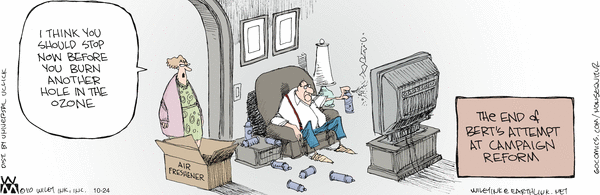
The "Occupy Wall Street" movement, which now appears to be spreading to other cities including Chicago, Boston, and Los Angeles, began as a
demonstration of public anger at economic and social inequality. People who have lost their homes to bank foreclosures, often with little or no oversight of a flawed process, people whose retirement savings have been wiped out by the shenanigans of unregulated Wall Street investment brokers, people who see their salaries capped or cut and their benefits taken away while the CEOs of their companies get huge raises, often despite mediocre performance - are finally getting fed up and taking to the streets. And why not? Their elected representatives aren't helping them. The average member of Congress owes his (or her) position to the contributions and support of the very individuals and industries that have brought the country to this sad state.
Both political parties are more interested in winning elections and smearing each other than they are in working together to combine the best of their economic ideas to help the fast-dwindling middle class. Never in my life have I been so disgusted with every politician whose smug, arrogant face shouts nonsense at me from my TV and radio. At this point, I'll be looking in November of next year for a button on the voting machine that just says "NO" in big letters.
All that having been said, I'm a little schizophrenic about the whole "Occupy Wall Street" thing. Here are a few of my points of thought:
1. America grew to be the world's economic powerhouse on the basis of a capitalist economic philosophy that rewards innovation and sound business planning. There are social and economic downsides to the capitalist philosophy, of course, but I don't think I could argue that the economic engine that built the United States from 13 squabbling colonies in 1776 to World War II's "arsenal of democracy" and the dollar from nothing to the world's benchmark currency could have been built without the freedoms, opportunities, and rewards provided under a capitalist system.
2. The American social ethic told the lowest stockboy in the warehouse that he could someday be the CEO of his own company if he worked hard, invested wisely, and got a good education. Today, sadly, we're working harder than ever for less reward, our investments are in the toilet, and education programs everywhere are on the chopping block as state and local governments try to save money and pay the bills by eating their seed corn.
3. Where we once rewarded innovation and prudent risk in search of future benefit, we now reward incompetence and wild speculation. CEO salaries in many large firms now exceed the incomes of the average worker by a factor of hundreds, and there's little rational thought given to how those salaries are set (you can read an interesting story on that
here).
4. Workers given two weeks notice of termination (if that) and a small severance package, often after years of watching their pay and benefits erode as management seeks to minimize costs and maximize profits, look in amazement at the huge "golden parachutes" given to executives who are fired for poor performance (you can read a recent story on that topic
here).
5. Well-meaning, but brain-dead social activists loudly support uncontrolled illegal immigration, which has a number of unfortunate results: it drives down wages as a result of providing swarms of workers willing (and forced) to take jobs at very low pay levels; it drives up the cost of health care by swamping hospitals with uninsured poor unable to pay for their care; and it drives up the cost of local government services (education, in particular) which must expand to cover new customers who are not contributing to the tax base that pays for those services).
So, where am I going with all this?
I've long said that we need to balance hard realism with soft idealism in this country. There was a time when we could do that ... when our political leaders negotiated with each other and came up with programs that at least tried to balance their competing social and political philosophies with the economic realities of what's possible. We don't see that now.
We see Republicans who mindlessly shout that all will be well if we remove all "job-killing" regulations from businesses and reduce taxes to near zero, and we see Democrats who thunder that taxing the rich and improving social programs (without regard to how they'll be funded) is the answer to all problems.
We need a lot of things in this country today, not the least of which is a group of leaders more interested in the country than in their narrowly-focused philosophies and quest for political power.
I'd put all that on my Christmas wish list, but I know I'd just find the same old brightly-wrapped coal and sawdust under the tree on Christmas morning.
Have a good day. Look at the facts, and get really mad. Then do something about it.
More thoughts tomorrow.
Bilbo