Showing posts with label A Low-Tech Guy in a High-Tech World. Show all posts

Tuesday, June 22, 2021

Why Augment Reality?


One of the latest tech fads is augmented reality, or "AR*." This is a technology which allows one to see the surrounding real-life environment with useful additional digital information overlaid on it. For instance, you might wear a pair of AR glasses which show the hours of operation or daily specials of a restaurant as you walk past it. AR goggles are used by some mechanics or technicians to let them read instruction manuals or order parts without using their hands while they work on your car. The Pokemon Go game which was (and still is, for all I know) popular uses AR technology to display the Pokemon creatures players try to capture.

I can see the value of AR for entertainment and for some jobs, but on the other hand, actual reality tends to suck, so why would we want to augment it?

Really useful AR would be more helpful on a regular basis if it provided immediately useful information, like hoods over the heads of passing racists, the location of the nearest bathroom**, or pop-up fact checking bubbles over the heads of bloviating politicians. The latter, though, is probably beyond the capability of current computer processing capability. Other useful AR functions might overlay danger symbols on people carrying concealed weapons, or flag people whose ability to drive is impaired by drugs or alcohol. 

We're not there, yet, though. There's only so much technology can do to compensate for the shortcomings of idiots, and we already have enough stupidity augmented by Fox News, OAN, and the crazier members of the GOP.

I'll just stick with plain old reality. If it needs augmenting, I'll do it myself. But if you find that AR program that shows where the nearest bathrooms are, let me know.

Have a good day. More thoughts coming.

Bilbo

* Not to be confused with the class of powerful semiautomatic weapons worshipped by many Americans.

** As an old guy, I could really use that!

Thursday, October 05, 2017

License Plates Smarter Than Drivers


From the Department of What'll They Think of Next comes the latest high-tech idea: smart license plates.

I call your attention to this recent article from CNET: Dumb License Plates Are About to Get Smart. A new digital license plate called Reviver attaches to your car like any other traditional, convict-made metal license plate, but uses Wi-Fi connectivity and a connection to your car's power system to act like an electronic tablet and display registration (and other) data. The Reviver plate offers a number of possible advantages:

You could instantly update your registration without waiting for your state Department of Motor Vehicles (DMV) to cash your check and mail you stickers to paste on the plate ... a signal from the DMV would remotely update the expiration month. This could also give the option for renewing registration month-to-month, for those who are trying to sell a car and don't want the hassle of trying to get their state to reimburse unused months of registration fees.

You could, theoretically, change the background design of your plate at will, using a menu of options similar to the list of plate designs already offered by most states. This would allow you to support your cause du jour without having to order new plates with the desired design.

If you got tired of your vanity plate message, you could apply online to change it and, once the new message was approved, you could download it and update your plate immediately.


The plate could link to your bank account and pay for parking by connecting to the payment system at parking garages.

Your plate could receive and project Amber alerts and other public service messages (although I'm not sure I'd want this without the ability to public service messages I didn't want or support).

It could streamline the management of large vehicle fleets.

And it could substantially reduce the risk of theft and fraud by ensuring that the plate wouldn't work if it was stolen and mounted on a different vehicle.

There would, of course, also be disadvantages:

The up-front cost of the smart license plate could be prohibitively high when compared to the cost of a traditional metal plate, at least when it was first issued and installed, although it might prove cheaper in the long run. Who would bear the cost?

Your state DMV could decide to generate additional revenue by pushing advertisements to your plate.

Like all Wi-Fi-enabled devices, it would be vulnerable to hackers who could change the plate number or use the connection to interfere with other electronic elements of the vehicle.

And finally, what happens if your car suffers a dead battery or an electrical system failure ... how do you prove to the suspicious cop or tow truck operator that it's really your car?

I think a Reviver-type automated license plate is coming ... it's a natural outgrowth of the available technology and the interconnectivity provided by the Internet of Things. My personal jury is still out on whether or not it's a good idea, but as nobody has asked my opinion, I guess I'll just accept it when it comes ... especially if it comes with an option to send messages to other drivers like, "Back off!" or "Turn down your $#%! high beams!".

Have a good day. More thoughts coming.

Bilbo

Tuesday, August 22, 2017

The Not-So-Living Doll, Revisited


Warning - adult theme ahead. You have been warned.

Last March, I wrote a post titled "The Not-So-Living Doll" that discussed a CNN report about the big business of making high-end, ultra-lifelike sex dolls. Having a perfectly good doll of my own that I married almost 35 years ago, and being in any case unwilling to spend north of $6,000 for a customizable artificial date, I found the story to be of only academic interest ...

... and then I read this article in the online journal Quartz earlier this month: Humans and Robots Are on the Cusp of a Sexual Intimacy We May Never Reverse.

Well, how about that?

The article is based on a study done by the Foundation for Responsible Robotics, the mission of which is, according to its website, "To promote the responsible design, development, implementation, and policy of robots embedded in our society ... to influence the future development and application of robotics such that it embeds the standards, methods, principles, capabilities, and policy points, as they relate to the responsible design and deployment of robotic systems."

The study - which is utterly fascinating and is titled "Our Sexual Future with Robots" - looked at seven "core questions" concerning the ethics and the technical issues of humans engaging in sex with robots. I found four of those questions to be particularly interesting (my comments added):

#1. Would people have sex with a robot? If there are people who will pay large sums of money for high-end sex dolls to have sex with today, I'm sure there will be people who will pay even larger sums of money for sex with a robot that would probably provide a more "reactive" experience while avoiding the potential emotional and financial entanglements of a human lover.

#3. Will robot sex workers and bordellos be acceptable? I think most people, particularly those who oppose the sexual exploitation of women, would accept such workers and businesses. There would, however, probably be the same backlash from religious groups that there is against "normal" sex workers and establishments, for the same moral and ethical reasons.

#5. Could sexual intimacy with robots lead to greater social isolation? We're living in a time when the widespread availability of online pornography ... not to mention simple online game play and the draw of constant communication on smart phones ... already causes social isolation. I'm not sure the involvement of robots would make things any worse.

#7. Would sex robots help to reduce sex crimes? This is an interesting question. One might suspect that allowing persons who commit sex crimes to commit them against robots instead of human beings might help reduce the number of such crimes. However, a human rights lawyer cited in the Quartz article noted that

"... [sex] trafficking has a lot to do with domination and power over another individual: things you can’t experience with a robot."

Robots are already replacing humans in many jobs, and in a dystopian future it's possible that they may replace emotional and physical intimacy for some people. In any case, concern over the relationship between humans and robots has been a fixture of science fiction literature for a long time.

Many years ago, as an impressionable teenager, I was hooked on a comic book series called "Magnus, Robot Fighter," that chronicled the adventures of a heroic human who fought against various robots that threatened humanity ... but as far as I remember, he never ended up having sex with any of them*.

Czech playwright Karl Čapek wrote a play titled "RUR" ("Rossums Universal Robots") in 1920, which predicted robot workers rising up against their human masters ...


 and author Isaac Asimov wrote a classic series of novels and short stories about relationships between humans and robots, starting as far back as 1939.

In the 1960s came a TV comedy titled "My Living Doll" that starred Julie Newmar** as AF-709, also known as Rhoda, a sexy female robot under the care of a psychiatrist. 


More recently, I've been watching the HBO series "Westworld," based on Michael Crichton's novel of the same name, which explores the interaction between humans and hyper-realistic robots that are slowly becoming self-aware and realizing how they are being victimized and exploited. The superb film "Ex Machina" covers some of the same moral and ethical terrain with the android Ava ...


And there are countless other examples of robots good and bad, from Commander Data of Star Trek to the villainous Ash and David of the Alien film series.

As we move into higher and higher realms of technology, augmented reality, and virtual reality, we are facing moral and ethical challenges we've previously had to face only in science fiction literature. We need to be careful.

Brave new world, indeed.

Have a good day. More thoughts tomorrow.

Bilbo

* And believe me, as an impressionable teenager, I'd have remembered that!

** Nobody could say "That does not compute" like she could.

Wednesday, August 09, 2017

Worrying About The Internet of Things


Agnes and I ordered a new refrigerator last week.

This was no small task, given that one no longer just goes out and buys what we used to call an "icebox" ... nowadays, there are vast numbers of styles and features that are available, depending on how much you need to store and how much you are able and willing to spend. An ice maker is a great feature, as is a cold water dispenser, but there are a lot of other things you can get, too. We actually looked at a refrigerator which had an internet-ready video screen ... not bad if you want to refer to the video for a particular recipe you're making, but a little bit more technology than we really needed. Or felt like paying another thousand dollars for.

That video screen option and the Bluetooth connection it uses make that fancy refrigerator a part of what has become known as The Internet of Things ("IoT") ... a growing network of computers and devices that communicate with each other and - theoretically - make life easier by helping us keep track of things and manage our day-to-day activities. If the refrigerator can tell you you're running low on milk, or that your lunch meat has passed its "best by" date, or your oven can suggest a better way to cook a particular recipe, or your light bulbs can tell you when they're about to burn out, it can only help, right? How about "smart highways" that can measure traffic density, flow, and speed and adjust traffic signals to help speed things along? They make life better, don't they?

Consider recent reports that high-end models of the Roomba automated vacuum cleaner could map your home, collect information, and send it to Google or Amazon or other vendors. And that the microphones in your Amazon Echo or Google Home voice assistants are always on, listening to (and recording) everything they hear around them.

Hmmm ...

The idea of machines getting together and realizing that they're actually more powerful than we are is not new. It's the idea behind horror stories like Harlan Ellison's classic "For I Have No Mouth, and I Must Scream," which led to other stories and films like the Terminator franchise and Stephen King's short story "Trucks*." More recently, Jeffrey Deaver's novel "The Steel Kiss" featured a killer who used Internet-connected devices to murder his victims.

Do I need a refrigerator that's smarter than I am? After all, I've managed to buy milk and eggs for decades without the fridge reminding me to do so. Should I worry about the vacuum telling someone how my house is laid out? It depends on whether it's sending that info to a tech-savvy burglar or to someone who wants to sell me carpets.

I'm hardly a Luddite, but I'm starting to get a little concerned about the relationships among the devices we use, especially when I don't know what's talking to what ... or to whom. I guess I'm just a low-tech guy in a high-tech world.

And that bathroom scale better keep its opinions to itself.

Have a good day. More thoughts tomorrow.

Bilbo

* Later made into a silly movie called "Maximum Overdrive."

** I don't actually have one ... I don't trust them.

Monday, April 17, 2017

The Best Toys, Ever


No, the Wi-Fi-enabled dildos we discussed the other day are not on the list.

I think I might have written about this before, but I'm not sure. In any case, my daughter sent me a link a while back to this interesting article from Wired - The 5 Best Toys of All Time.

At a time when every child over the age of three has a tablet computer and large numbers of toys with flashing lights, noises, Wi-Fi connections, and other high-tech bells and whistles, there are a lot of traditional toys that many of us grew up with and found wonderful ... even in the absence of power and an Internet connection. Here are the five classic toys:

1. Sticks.


2. Cardboard Boxes.


3. String.


4. Cardboard Tubes.


5. Dirt.


There are a few more items that I could add to this list, based on my own childhood:

6. Empty thread spools.


7. Buttons.


8. Empty film cans.


9. Paper plates.


My young childhood was spent in the 1950s and early 60s, and I can tell you that I spent countless hours at play with all five of the items on the list. They didn't need batteries, cables, or an Internet connection. They were always available. And they could be combined in endless ways to facilitate imaginative play. Sticks became guns, swords, spears, and any number of other, less violent things. Cardboard boxes became cars, aircraft, tanks, space ships, treasure chests, and other things. We used string to make snares and booby traps, and cardboard tubes made excellent rifles, rocket launchers, and castle turrets.

Dirt ... real dirt ... was great fun, too. I was lucky enough to grow up in a suburb of Pittsburgh, Pennsylvania, that was at the time not yet heavily developed. Houses were not built on postage-stamp sized lots, and so there was plenty of space to play. There were large stands of trees, vacant lots, and an abandoned stone quarry across the street. We climbed trees, investigated bugs, and got very dirty picking berries, splashing around in the creeks, and digging forts and tunnels in the acres of available dirt.

And none of it cost a thing. Well, except for the amount of soap and laundry detergent our parents had to buy to keep us presentable.

Nowadays, we don't like our children to get dirty. Clothes and shoes are too expensive, and we're always worried about the toxins and insects that are lurking in the soil. We don't believe it's safe to get dirty any more.

As for my own additions to the list, my mother and grandmother were both seamstresses, and as a result we always had lots of empty thread spools. Nowadays, they're all made of plastic, but back then they were made of wood, and were useful for making all sorts of things, from necklaces to small turrets on cardboard castles. And buttons were neat, too ... they were colorful and came in all sorts of shapes and sizes suitable for stringing together or gluing on to other things. We made "button trees" at Christmas and four-leafed button clovers for St Patrick's Day, and my father was still making them in his last years of assisted living.

Because my father was a professional photographer, we always had lots of empty film canisters, too. The older ones were metal and had screw-on caps; newer ones were plastic with snap-on lids. They were great for storing our other small treasures, like neat rocks, bugs, or whatever.

And let's not forget those paper plates! Before the plastic Frisbee, we sailed paper plates around the yard, or stapled them together to make flying saucers that would land threateningly on the cities we'd carved out of the dirt in the yard.

A while back, I used a cardboard box, cardboard tubes, and string to make a castle with a working drawbridge for my granddaughter. It wasn't as elegant as the huge plastic castles you can find at the big-box toy stores, but because we worked together to build it, it was special. And it took me back to a time when I wasn't worried about mortgages and car payments and what Mr Trump was going to do next.

The best toys really are the ones that unleash our childrens' imaginations and let them be creative. They don't need to have proprietary wires to hook them up, and they'll work even when the power is out. I was reminded of the tag line from the 1992 movie Radio Flyer - powered by imagination.

Probably the best power there is.

Have a good day. Enjoy simple things.

More thoughts tomorrow.

Bilbo

Wednesday, June 01, 2016

Dark Patterns


No, this post does not provide you with laundry hints about what sort of patterns not to wash with your light patterns. Today, we look at an interesting topic that I think I vaguely knew about, but didn't realize had a name and a pedigree of sorts. Listen up - I think you'll find this both interesting and unsettling.

I came across the term "dark pattern" on WordSpy, where it was defined this way:

noun. A website design feature that attempts to trick a user into doing something they might not do otherwise.

If you're like me*, you have often found yourself faced with a confusing set of choices or settings on websites that leave you befuddled as to what exactly you are supposed to do to achieve the end result you wish. It may be a difficult process for unsubscribing from an e-mail list, the insanely convoluted system by which you can adjust your privacy settings on Facebook, or the relentless pressure exerted by Microsoft to force you to upgrade to Windows 10. Whatever it is, you and I have become the victims of a dark pattern, a software or website setting specifically designed to trick you into taking an action you might otherwise not wish to perform.

For instance, you might face advertisements designed to prevent you from making apples-to-apples comparisons between the same products at different stores ... perhaps by setting the price in odd quantities or by bundling them with other products you might not otherwise want. Another example is the special free-trial offer that requires you to submit your credit card information up front, and then automatically charges you to continue with the product or service unless you "opt out" ... a process that is generally made confusing and difficult enough to make you just shrug and keep whatever it is. You can see other examples of dark patterns here.

Dark patterns abound this year ... consider the candidacy of Donald Trump, who wants you to vote for him because he will "make America great again." The dark pattern here is that a vote to "make America great again" will fulfill that promise by ignoring the Constitution, accepting complete rejection and denial of documented facts, and destroying the philosophies and behaviors that actually do make America great.

Beware of dark patterns, especially when camouflaged in orange.

Have a good day. More thoughts tomorrow.

Bilbo

* And heaven help you if you are.

Tuesday, March 29, 2016

Who Writes This Stuff?


Just a quick rant today ...

Yesterday morning at work, I booted up my computer and when my login screen appeared, I typed in my personal ID code. Instead of logging me in, the system popped up this message on my screen:

"Provider could not perform the action since the context was acquired as silent."

What??

After a while I figured out the system was telling me that I had not engaged the number lock on my keypad before typing in my ID code.

So riddle me this, Batman ... why couldn't it just tell me that? What IT ass clown figured that an ordinary computer user would understand this malarkey?

Who writes this stuff?

I don't know about you, but I'm ready to relocate ...


Have a good day. More thoughts tomorrow, assuming I can convince the network to let me in.

Bilbo

Thursday, September 17, 2015

Modern Telephone Etiquette


We all have stories about bizarre behavior exhibited by people using their cell phones in public. I've written here about the clueless traveler who broadcast his credit card number to a subway car full of people while booking a hotel reservation, the dumbass who shared with all of us in the airport gate area his argument with his proctologist's appointment clerk, and the cone of silence some people seem to think descends around them when they carry on highly personal calls from a stall in the men's room ...


But what are the new rules of etiquette that govern use of cell phones in public? I don't know that they've been written down anywhere a la Emily Post, allowing people to do pretty much whatever they want in public. After all, we seem to live in a time of extreme self-centeredness, where one can do whatever one wants, and those who object are the ones with the problem.

So ...

What are Bilbo's recommended rules for modern telephone etiquette? Here are a few:

1. If it's personal, keep it personal. The rest of us don't care about the fight you're having with your spouse. Save the argument for later when you can have it in the privacy of your home.

2. We don't need to know your medical history or the details of your business. Really. If you want to discuss that mysterious lump with your doctor, tell your significant other how your prostate exam turned out, or show the world what a big wheel you are, wait and do it in private ...


3. Don't shout. Yes, we know that cell phone connections aren't always the best, but we don't need you bellowing into our ears so you can have that conversation that absolutely can't wait.

4. Don't ignore the person in front of you to answer a call, unless it's an emergency. This is just plain good manners. Interrupting a live conversation to take a call tells the person you are talking to that they're not as important as the call you need to answer.

And since telephones aren't just telephones any more, there are a few other rules of etiquette that also apply ...

5. If you are with someone, leave the phone alone. Checking Facebook, Twitter, or your e-mail every two minutes, or playing an online game tells your partner they're not important to you ...


6. Selfies are not always necessary or desired. If you want to take your picture with someone, ask their permission before whipping out the phone to shoot the photo. And remember that it's not always appropriate to take selfies everywhere ...


7. Speaking of taking pictures, don't take anyone's picture without their permission. You wouldn't do it with your big 35mm SLR camera, so don't do it with your phone.

8. And one last word about photography: if you come into an emergency situation, help the people in trouble before you take the picture or shoot the video for the local TV station. I'd like to think this is common sense, but we all know that common sense is less common than it used to be.

For more about how telephone etiquette is changing, you can read this short article by Adrienne LaFrance.

Have a good day, but don't call me from a public place to tell me how good it is. And don't call me after 8:00PM, either.

More thoughts tomorrow.

Bilbo

Thursday, July 02, 2015

Robot Wedding


From the Department of I Couldn't Make This Stuff Up comes this major news story: the world's first robot wedding took place in Japan last Saturday.

I can understand you not noticing this event, because in the past week we've been concerned with weddings of other sorts here in the US of A, but this is really a big deal ... after all, it's not every day that two inanimate objects get married. Here are a few pictures from the Big Event ...

As you can see, the groom - a handsome mechanical man named Frois - decked himself out in a smart black bow tie, while the blushing bride, Yurikin, wore a traditional white dress.


The ceremony culminated with the traditional kissing of the bride, although there was perhaps a bit more tongue involved than most of us are used to ...


And the reception featured the traditional wedding cake, the batter for which was made with eggs, flour, sugar, and 40-weight oil ...


You can read the whole story and watch the video here. Be sure to read the comments after the story ... they're the best part. Here are a few samples:

"The wedding night must have sounded like a #10 tin can filled with marbles;"

"I wonder if they had to get an electrician's signature on the marriage certificate to verify circuit board compatibility;"

"I wonder how they procreate? Do they need lubricant or is it all show and no go? Either way, SCOTUS* will allow it;" and finally,

"Shame on you haters! You're all robophobic..."

Of course, there are other things to think about in conjunction with this wedding. For instance, one wonders about who the maid of honor might have been ...


Or the best man ...


The mother of the bride ...


And nowadays, you need to have security at high-profile public events ...


Yes, Dear Readers, nowadays in America marriage is a right we grant to everyone, regardless of sexual orientation. In Japan, it's a right granted regardless of mechanical construction. They're way ahead of us.

Have a good day. You may now tune up the bride.

See you tomorrow for the announcement of our Right Cheek Ass Clown for July.

Bilbo

* Supreme Court of the United States, in case you're not familiar with the acronym.

Tuesday, November 18, 2014

Conference Calls


The economy being what it is, there's not a lot of money in most organizations for discretionary travel. There was a time when I was off on some business trip or another at least once a month ... one year, I was working a project for which I traveled so often to Colorado Springs that I got a Christmas card from the manager of the Holiday Inn where I always stayed.

But that was then, and this is now. Unless you're the CEO of a major corporation or a member of Congress whose travel is paid for by the CEOs of major corporations, you figure out ways to get things done without traveling. The main way this is done nowadays is by videoconferencing or audio conference calls.

Videoconferencing is nice because you can see the people at the other end, and you can get the feeling - almost - that you're in the same room dealing with them. The downside is, of course, that they can see you, too. It can be embarrassing to fall asleep while the camera is on you, or to see on screen that the notes you're taking are actually on a crossword or sudoku puzzle.

Conference calls are better. No one can see you on screen, so if you're participating from home, you can do so in your pajamas (or less) and no one is the wiser. There's no camera (which can often be controlled by the people at the far end) to see what you're really doing while you're on the call with the mute button pressed.

And what are you doing? According to this article in the Harvard Business Review, these are the top things people are really doing while they're on a conference call*:


I'm usually doing other work**. So, what do you do during conference calls, Dear Readers? Leave a comment and let me know. Or we can always discuss it on a Skype or FaceTime call. Just be fully clothed when you call in, if you don't mind.

Have a good day. More thoughts tomorrow.

Bilbo

* If you add up the percentages, it comes to 378%. There must be a lot of people on that call.

** I almost said, "doing number one or number two," but thought better of it.

Monday, November 03, 2014

Passwords


We all know that the Internet is a wild and wooly place, full of morons who think it's great fun to screw with your data, criminals who want to steal your identity, and spies who work very hard to steal trade and national secrets stored online. How do we protect ourselves?

One way is with the good old, trusty, password. You know: that combination of letters, numbers, and "special characters" that is supposed to keep the bad guys out. If you're lucky.

But let's face it: passwords are a pain in the neck. Ones that are easy to for you to remember are also easy for the virtual douchebags to guess, and ones that are complex and difficult for bad guys to figure out are also impossible for you to remember. And you have to have dozens of them, because the security experts tell you that you should never use the same password for more than one network or website, because if it's compromised it will give the slimeballs access to lots of things you'd rather protect.


At work, I have accounts on five ... five ... different networks. Each network requires a different login and password for access, and once I'm on a given network, most of the websites I need to visit have their own logins and passwords.

And the rules for generating passwords are different on each network and for each website. Some require as few as six characters (upper or lower case letters, numbers, or "special characters"), and some 15 or more. Some will reject a password that contains a word found in the dictionary, or more than three of any sort of character in a row, or a password that duplicates any of your last 25. Some require certain numbers or combinations of characters at certain points within the password (such as two "special characters" within the first five places).

It's enough to drive you crazy. Of course, in my case it's only a short putt, but that's not important now.

Here's a typical set of password generation rules:

"All passwords must contain a minimum of 137 characters and contain at least 28 lower-case letters, 29 upper-case letters, 11 digits (no two the same), 3 special characters, 5 punctuation symbols, 2 Cyrillic characters, four Egyptian hieroglyphs (not including the left-facing hawk or the Eye of Horus, which are reserved), 14 wingdings, 13 hexagons**, 11 imaginary numbers, 18 consonants, 7 dipthongs*, 12 Latin adjectives, 8 Sanskrit nouns, 4 subjunctives, a dangling participle, and the Batman symbol. Your password must not be evenly divisible by 2 or H. Upper and lower case letters must appear in groups of three and be separated by at least three prime numbers or Chinese pictograms. You may not reuse any of your previous 596 passwords, your new password may not contain any words in Old Church Slavonic or High Valyrian, and will be valid for no longer than 30 days. We will begin reminding you to change it three days from now."

And people wonder why my hair is gray and I drool a lot.

I remember the good old days, when "Password" was a fun television game show ...


... and not a way to drive you crazy ...


Have a good day. More thoughts tomorrow ... if I can remember my Blogger desktop password.

Bilbo

* In this instance, "hexagon" does not refer to the outcome of a successful exorcism.

** No, this does not refer to extremely revealing bathing suits.


Wednesday, March 05, 2014

Don't Touch That Dial!


I love being a grandparent. I have the fun of watching my grandchildren grow up, and the job of passing on to them the lessons I've learned through hard experience. It's also very interesting to watch them learn about the world around them ... which is, in countless ways, a very different world than the one in which I grew up. I'm amazed at how easily they've picked up on modern technology - at age 3, my granddaughter Elise understands and uses Agnes's iPad better than Agnes does. Or I do, for that matter.

I found this marvelous video on Miss Cellania's website this morning, and just had to share it with you. Warning up front: if you are a superannuated old coot like Mike and I, this is guaranteed to make you feel really old. Dear Readers, I give you the spectacle of modern children trying to figure out how to use a rotary phone ...


Feeling old yet?


Have a good day. More thoughts tomorrow.

Bilbo

Sunday, June 23, 2013

Getting All Keyed Up, As It Were ...


Ah, the things you learn from surfing the web ...

It was on this date, June 23rd, of 1868 that a gentleman named Christopher Sholes was awarded a patent for the first practical manual typewriter. There had been other such machines designed before that time, but Mr Sholes' machine was the first one to combine the features of size and weight that would make it practical for manufacturing and regular use. This is what a later version of Mr Sholes' typewriter looked like ...


The original version had a much different keyboard, designed to resemble the keyboard of a piano - it had two rows of keys, the upper being white (ivory) and the lower black (ebony). It did not contain the numbers 0 and 1, because the inventor figured that space could be saved by using the letters "o" and "l" in their place. An article in Scientific American magazine referred to the typewriter as a "literary piano."

Various versions of the Sholes typewriter used systems of springs or weights to make the keys return to their original positions after being stroked, and a continuing problem with the design was that keys often tended to jam when newly-struck keys collided with those returning to their home positions. This led to the experimentation which resulted in another invention by Mr Sholes - the famous QWERTY keyboard we still use today, in which the keys are arranged to prevent more commonly used letter combinations from jamming each other.

In 1875, Mr Sholes sold the patent for his typewriter to the Remington Arms Company, a noted manufacturer of firearms, for $12,000. Remington sold the typewriter business in 1886 to the Standard Typewriter Manufacturing Company, after deciding that it's marketing slogan - "Typewriters don't kill people, people kill people," was not generating the desired volume of sales.

And there you have it - the story behind the device that, if you are of my age or older, was a mainstay of your college or early business years. Nowadays, instead of having to replace often-messy typewriter ribbons (which came with a black row and a red row for two-color printing, woo-hoo!), we have to replace ink cartridges that come in a bewildering and incompatible range of colors, sizes, shapes, and prices, and are designed to warn you to replace them when the ink level drops below 90%.

Technology marches on.

Have a good day, and enjoy the rest of your weekend. More thoughts on Tuesday.

Bilbo


Thursday, April 25, 2013

Of Cell Phones and Toilets


Do you remember a time - long, long ago - when there were no cell phones? When, in order to use a telephone, you actually lifted a receiver that was connected to a base unit with a wire, then dialed a number?


In fact, when was the last time you actually dialed a number, as opposed to poking it into a keypad?

Do you remember a time when you took pictures with a camera, surfed the web from a desktop PC, and detonated bombs the old-fashioned way?


Yes, Dear Readers, people not much younger than I will scarcely remember a time when we didn't have portable, or cellular phones. We have been freed from the wires that limited us to a short radius of distance from the telephone base unit. We can roam wherever we like, having the most personal of conversations no matter where we are and who else may be listening. As long as there are enough bars*, you can talk to anyone, anywhere, at any time, about any subject, no matter how inappropriate or personal**.

Cell phones are everywhere. You can't escape.


In fact, according to this article I read last month in Time Magazine, more people in the world have cell phones than toilets. Consider this quote from the article ...

"Out of the world’s estimated 7 billion people, 6 billion have access to mobile phones. Far fewer — only 4.5 billion people — have access to working toilets. Of the 2.5 billion who don’t have proper sanitation, 1.1 billion defecate in the open, according to the study."

Well, those who have cell phones also frequently defecate in the open, just verbally.

I end this discourse with a message from your uncle:


Do it now. The rest of us will thank you.

Have a good day. Quietly. And come back for Cartoon Saturday.

Bilbo

* Speaking of bars, I think I could use one.

** I believe I've shared with you the very loud conversation I once overheard in Washington National Airport (I refuse to call it Reagan National Airport), in which an angry fellow was berating the person on the other end of the line for not getting him the desired appointment ... with his proctologist. Way more information than we all needed.

Tuesday, January 22, 2013

The March of Entertainment Technology


Yesterday I read a very interesting blog post from Occasional Reader rashbre, in which he asked the interesting question, "When Did Hi-Fi Become A/V?"

When, indeed? Cue the background music for the walk down memory lane ...

I remember back when the height of musical reproduction technology was the record player ...


It was a relatively simple device, and could be used to play 78-, 45-, or 33-rpm records (which operated by pressing grooves into a vinyl surface, which were then "read" by a needle that picked up variations in the groove surface and transmitted them to a membrane which vibrated to produce tinny sound).

The simple record player gave way to the high-fidelity (or hi-fi) system, also known as the stereo, in which the grooves in the record became more complex and were able to reproduce multiple channels of sound, fed to two or more speakers. This gave a richer sound than the simple monaural tones of the record player. I remember when my father bought our first stereo - a KLH model that looked like a sleek record player, but produced a much sharper, clearer sound ... the chipping sounds in the song "Chip, Chip" by Gary Lewis and the Playboys were very, very different than the same sounds played by my old record player.

We then learned about reel-to-reel tape, 8-track tape, and tape cassettes, which allowed us to record the music we played on the hi-fi or heard on the radio. Naturally, these three systems were incompatible with each other.

Records in time yielded to compact discs (or CDs), in which music once encoded in grooves on vinyl and read by a vibrating needle was now digitally encoded on a small, hard plastic disc read by a laser. CD's couldn't, unfortunately, record music the way audio tapes could, but were soon overtaken by recordable CDs that fixed that problem, but required a player that would also allow recording.

So, now we had the stereo, the tape player (of whichever type), and the CD player ... which were tied together to make a sound system, and which required a new type of furniture to hold them conveniently close together. This led to the birth of the stereo cabinet ...


But television was also moving along! The simple old black and white CRT television, which was very large and weighed about 7,000 pounds, was gradually replaced by the color CRT television, which in its turn yielded to smaller, thinner, and somewhat lighter models, culminating in the modern ultra-thin, wall-mounted high-definition television.

And that high-definition television and high-powered sound system required better reproduction ... leading us to surround-sound.

Likewise, we were able to purchase movies to watch at home on video tapes (either VHS or Beta), which were augmented by laser discs and eventually replaced by the digital video disc (DVD - now digital versatile disc), which is now being edged out by the Blu-Ray disc and by the digital download ... which requires no medium at all.

Which led to the replacement of the old sound system with the audio-visual (or AV) or home theater system.


The home theater system is a wonderful thing, combining radio, recorded music, video, gaming, recording and playback, computer access, and cable/satellite TV feeds in one convenient* system, the heart of which is the Tuner - a device roughly equivalent to the average NASA command system, but somewhat more complex. The average tuner can only be installed and operated by someone with a dual degree in electrical engineering and criminal psychology**.

And that, Dear Readers, is your abridged journey through the meandering road we took from hi-fi to AV and beyond. Thanks to rashbre for the inspiration.

Have a good day. Enjoy that home theater system once you figure it out. More thoughts on Thursday.

Bilbo

* Assuming you can figure out how to operate it.

** The criminal psychology degree will help you understand your desire to murder the sadistic bastard that designed the tuner and wrote the unintelligible 650-page instruction book.


Thursday, September 06, 2012

Updated Sayings


My friend Bob (no, not that Bob, the other Bob) sent me an e-mail the other day with a list of cleverly updated aphorisms for the 21st century. I thought they were share-worthy, and so ...

- Home is where you hang your @.

- The e-mail of the species is deadlier than the mail (with apologies to Rudyard Kipling).

- A journey of a thousand sites begins with a single click.

- You can't teach a new mouse old clicks.

- Great groups from little icons grow.

- Speak softly and carry a cellular phone.

- C:\ is the root of all directories.

- Don't put all your hypes in one home page.

- Pentium wise; pen and paper foolish.

- The modem is the message.

- Too many clicks spoil the browse.

- The geek shall inherit the earth.

- A chat has nine lives.

- Don't byte off more than you can view.

- Fax is stranger than fiction.

- What boots up must come down (or just crash).

- Windows will never cease.

- In Gates we trust.

- Virtual reality is its own reward.

- Modulation in all things.

- A user and his leisure time are soon parted.

- There's no place like ( http://www.)home(.com)/

- Know what to expect before you connect.

- Oh, what a tangled website we weave when first we practice.

- Speed thrills.

- Give a man (or for that matter, anyone) a fish and you feed him for a day; teach him to use The Net and he won't bother you for weeks.

And, of course, the obligatory cartoon ...


Any other suggestions, anyone? Leave a comment.

Have a good day. More thoughts tomorrow.

Bilbo

Friday, January 27, 2012

A Sign(ature) of the Times

We're going to take a day off from our tour of the Constitution because I've been distracted by another intellectual shiny object - the disappearance of the signature.

I stumbled on this fascinating article in The Atlantic magazine yesterday: "Signing Off: The Slow Death of the Signature in a PIN-Code World." The bottom line of the article is that something that used to be one of the defining elements of our identity - our signature - is going the way of the dodo, the Edsel, and a useful and functioning Congress.

There was a time not so long ago when signing your name on the proverbial dotted line was a big deal. It meant that you had committed yourself to something, agreed with a position, took on a debt, acknowledged receipt of an item. The ink you put on paper was a visible and indelible (well, pretty much) symbol of your honor and commitment.

It's different now.

Today, when the UPS or FedEx guy shows up at the door and needs a signature, he hands you an electronic pad, on which you make a few odd marks with a stylus. When you use your credit card in most stores, you "sign" an electronic capture window ... and your "signature" usually looks absolutely nothing at all like your real signature. In many cases, you don't even need an electronic signature - you "sign" by entering a PIN (personal identification number) that transfers your digital credentials to the correct spot on a computer-generated form.

Somehow, I just don't think this is right. Call me a luddite, but I think there's something vital and important about a real, as opposed to a digital signature. Would the Declaration of Independence have been as impressive and meaningful without the bold statement made by John Hancock?

Indeed, even today we speak of "putting your John Hancock" on a document. "Putting my PIN on the line" doesn't have the same ring to it.

I have other problems with the spread of digital signing technology, too. I have a problem with the fact that my signature has been digitally captured (if poorly) and stored in zillions of different places. The possibility exists that someone could steal that digital copy and use it to sign other things in my name. Not everyone agrees with me, though. Consider this excerpt from the Atlantic article:

"Fraud rates on credit or debit cards that are signature-based are much higher than on cards with PIN protection," notes Chris Hawkins in his book A History of Signatures: From Cave Paintings to Robo-Signings. In 2005, a consulting firm found that signature-based debit card fraud rates were 15 times higher than PIN-based fraud rates.

You'll pardon me if I don't find that comforting.

Electronic signatures may be the way of the future, but I still prefer my beloved dipping pens ...

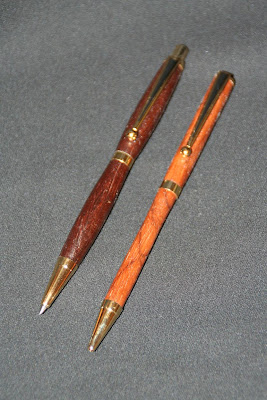
and the beautiful turned-wood pen and pencil set Agnes made for me a few years ago ...

To me, ink on paper is just more ... real. And in a time when things that are real are few and far between, that's a comforting thing.

Have a good day. Be here tomorrow for Cartoon Saturday.

More thoughts then.

Bilbo


Wednesday, January 18, 2012

I'm Finished, You Can Swipe the Page Now

You know, Dear Readers (and are probably tired of hearing about it) that I'm a reading purist - although I own an iPad that has three different e-reading programs on it (Kindle, iBooks, and Overdrive), I much prefer the heft, feel, and - yes - smell of a real ink-on-paper book. Reading a book on a digital reader is convenient, especially while traveling or commuting, but it just doesn't give you the same sensory experience of a real book.

That said, e-readers and digital books are here to stay. But what about their availability and overall utility?

You may be interested in this article from last Saturday's Washington Post: As Demand for E-Books Soars, Libraries Struggle to Stock Their Virtual Shelves. It's an interesting article that confirms what I had already long suspected: that it can be extraordinarily difficult to check out a digital book from your local library, and the wait can be as long or longer than the wait for the same title in traditional ink-on-paper.

The publishers of books are facing the same threats in the digital world that the music and film industries have faced over the last decade, and are trying to avoid the mistakes made by those industries by coming up with a technology and business plan that will protect the financial interests of authors and publishers while still making books available to readers. This is not a simple task.

Some publishers (like Simon and Schuster) are refusing to make their titles available to libraries in digital format, or are severely limiting the number of copies of digital titles they will provide to a single library, because they're afraid of piracy. I know from personal experience that the wait for a digital title from my local library is generally a good deal longer than the wait for a real book. And that's not to mention the problem (from a reader's perspective) that there are several contending (and incompatible) digital formats designed to protect proprietary interests and foil digital pirates.

You can buy a real book and lend it to your family and friends without restriction ... but not so a digital book. Although there are some very limited exceptions, if you want to lend an e-book to a friend, you have to give them your entire reader. And you need a degree in electrical engineering to configure and authorize your computer and reading device to enable download of a title for which you've paid (or which you've properly downloaded from your library). Oh, and I haven't even mentioned the difficulty of obtaining a legal digital download of a movie for which you've paid ... if you're interested in the details of my digital nightmare, I'll e-mail them to you.

Oy, vay.

I understand the importance of protecting the right of an author (or musician, or actor/director) to make a living from his or her talent. But we need to remember the poor reader, too: if digital reading gets to be too onerous a task, fewer people will do it ... and we have a woefully underinformed population already, anyway.

At the moment, I am reading four books: three traditional (Inferno, by Max Hastings, which Agnes gave me for Christmas; Iago, by David Snodin, and Supervolcano: Eruption, by Harry Turtledove, both borrowed from my local library), and one e-book (Abraham Lincoln: Vampire Hunter, by Seth Grahame-Smith). The e-book is easiest to handle and transport, making it a much better choice for hauling along on my daily commute, but making for a less satisfying reading experience.

Oh, and did I mention that our local Metro transit system is being plagued by a rash of robberies in which personal electronics (smartphones, tablet computers, and game players) are stolen from commuters ... sometimes with injury?

If someone tries to steal my copy of Max Hastings' Inferno, I can hit him with it and do some significant damage. If someone tries to steal my iPad ... well, let's just say I'd be reluctant to smash it over his head.

Digital books are here to stay, and they have their place in my library.

But I don't have to like them.

Have a good day. Read more, either digitally or traditionally.

More thoughts tomorrow.

Bilbo

Monday, December 26, 2011

Have Yourself a Digital Little Christmas

Well, Christmas is over for another year. The packages have been unwrapped, the gifts examined and gushed over, the big dinner eaten, and all the pretty wrapping paper stuffed into bags and set out for the trash collector. And we'll do it all again in another 365 days or so, because that's what we do. Unless, of course, you are a Nigerian Islamic radical, in which case you'll blow up a few churches because you are a stupid psycho who thinks it's okay to kill people who don't believe the same way you do.

Christmas customs around the world vary quite a bit, don't they?

But my post-Christmas rant is not about religious bigots who are busy creating their own hell. It's about digital movies.

There was a time, not so long ago, when you went to the movies in a theater. You sat in a soft chair (usually behind someone large enough to block your view), ate overpriced popcorn, and then went home with the memory. Then the movies came to you on television. Soon they were available on VHS (or Beta) tapes you could buy or borrow to watch whenever you wanted. Then came DVDs. Then came Blu-Ray discs. And then came the digital download.

This is why God invented aspirin.

One of the gifts Agnes gave me for Christmas was a "combo pack" of the movie Cowboys and Aliens (the 21st century successor to such low-tech film classics as Billy the Kid vs Dracula). The "combo pack" includes a DVD, a Blu-Ray disc, and a coupon which allows me to obtain a digital copy of the film to play on my home computer, laptop, or tablet. How cool is that? Next, they'll be beaming the movie directly into my skull via satellite.

Well, not so fast, buckaroo. I sat down at my computer this morning to download my digital copy, a process that used to be quick and simple: you put the disc into the computer, selected the connection to the download website from the disc menu, poked in your 9,796-character redemption code, and the electrons marched down the digital highway to your computer and arranged themselves in proper formation for future viewing.

But that was obviously too easy. Now, there's a system called Ultraviolet, designed by the great-grandson of the Marquis de Sade, which requires you to give up vast amounts of personal information to create multiple accounts in order to not allow you to download the movie for which you have paid. It took me a great deal of time and agony to work my way through Ultraviolet's insanely complicated system, only to be petulantly told that my redemption code was rejected because it had already been used ... obviously by someone who carefully opened up the shrink-wrapped case, copied the code, downloaded my movie, and cleverly re-sealed the package.

I took a few minutes to send a blisteringly uncomplimentary e-mail to the Ultraviolet feedback address, where it will probably be outsourced to some Nigerian psycho who will try to blow up my computer for not acknowledging that Ultraviolet is the final and ultimate revealed way to get your movies.

It didn't take long to get over that Christmas spirit, did it?

But I'm going to take a few deep breaths, center myself, and spend my last day of Christmas vacation doing as little as humanly possible. I'm going to relax, watch my movie (from the Blu-Ray disc, of course), eat leftover Christmas dinner, and generally vegitate before having to return to the office tomorrow.

And who knows? - perhaps, in spite of all expectations to the contrary, someone at Ultraviolet might contact me with an apology and my digital download.

And Dracula might beat Billy the Kid, too.

Have a good day. Enjoy the rest of the holiday season.

More thoughts tomorrow.

Bilbo